Your Guide to Europe’s China Shock Trade Debate: Assessing the EU’s Available Instruments
Executive summary
• China’s surging exports, driven by mercantilist policy and weak domestic demand, are hollowing out European industry. If the EU finds the right policy mix to address this challenge, it can restore and improve its competitiveness. The EU has various tools at its disposal, but its course of action in response to this is yet to be defined.
• China’s economic model creates structural issues for the EU’s economy. The ongoing export surge is not only fuelled by Chinese companies’ efficiency and capacity for innovation, but also by deep market distortions, an undervalued currency and weak domestic demand.
• Even the countries and industries that used to benefit the most from trade with China, such as the German car and machinery industries, now face increasing pressure. While member states’ exposure to trade with China differs, this convergence paves the way for more decisive EU measures.
• Both action and inaction come at a cost. The cost of action would be likely Chinese retaliation, the cost of inaction further erosion of the EU’s industrial base, with long-term consequences for prosperity and innovation as well as social and political stability.
• Effectively tackling the shock to the EU’s manufacturing base while minimising costs and managing the risk of Chinese retaliation requires a close examination of the EU’s trade toolbox: which measures can it use, what are their limitations, and where are the gaps?
• The paper assesses the EU’s existing trade instruments: Which problem are they meant to solve, how do they work and (when) would this work? It also discusses potential new instruments such as an EU equivalent to US Section 301, an EU solidarity instrument and investment conditionality in strategic sectors.
• In its reaction, the EU should focus on three priorities:
• Finetuning and using its existing trade toolkit, especially anti-dumping and anti-subsidy duties, instead of delaying action until new instruments are adopted.
• Defining landing zones in negotiations with China. This should translate into concrete targets and demands which, even if unmet by the Chinese side, would anchor the discussion.
• Leveraging the China trade measures for a holistic economic growth and competitiveness strategy, including the completion of the Single Market and the Savings and Investment Union. Providing an effective and coherent European answer to surging Chinese exports is crucial to unlock the Single Market’s growth potential.
Introduction: Why the EU needs to reshape its trade relationship with China
The EU’s economic relationship with China is becoming increasingly unsustainable. This diagnosis has become a widespread consensus in the EU this year, especially as US tariffs increase the pressure on the European exporters. Firms report drastic losses of market share in China, its imports of European goods have fallen in the last years, and Chinese sales of cars and machinery are rising in the EU and on third markets. Europe’s and China’s economies are increasingly moving from complementarity to competition. This has been dubbed the “second China shock”.
The first shock followed China’s accession to the World Trade Organization in 2001 that affected light industries like clothing and furniture more than European cars and machinery. Now, China’s long-standing industrial policy strategies, such as “Made in China 2025”, threaten not only high-profile sectors like electric vehicles, but also to disrupt European manufacturing more broadly. This has spooked the EU. At the June 2026 European Council, leaders mandated the Commission to come up with workable policies to respond to the shock. The mandate has received broad support, even in traditionally dovish Germany. But the debate about how to design workable measures is continuing. All policy options may raise prices and prompt Chinese retaliation, but the cost of inaction may be higher. Conversely, getting this right would be a key step to unlock EU growth and competitiveness.
This means that the EU faces some tough strategic choices, but also very concrete questions: which measures should be applied in which sectors, and what may be missing in the toolkit? This policy brief presents three main drivers of the current EU-China trade debate. It then provides an overview of the EU’s existing and potential new instruments, the problems they are meant to solve, as well as their contribution in the current situation. It then concludes with three recommendations: The EU should use the tools it has now instead of waiting for the perfect new toolkit, it should continue to look for landing zones when negotiating with China, and it should embed the China trade debate within a broader growth and competitiveness strategy.
What will drive the EU’s China debate this autumn
1 | China’s economic model creates structural issues for the EU’s economy
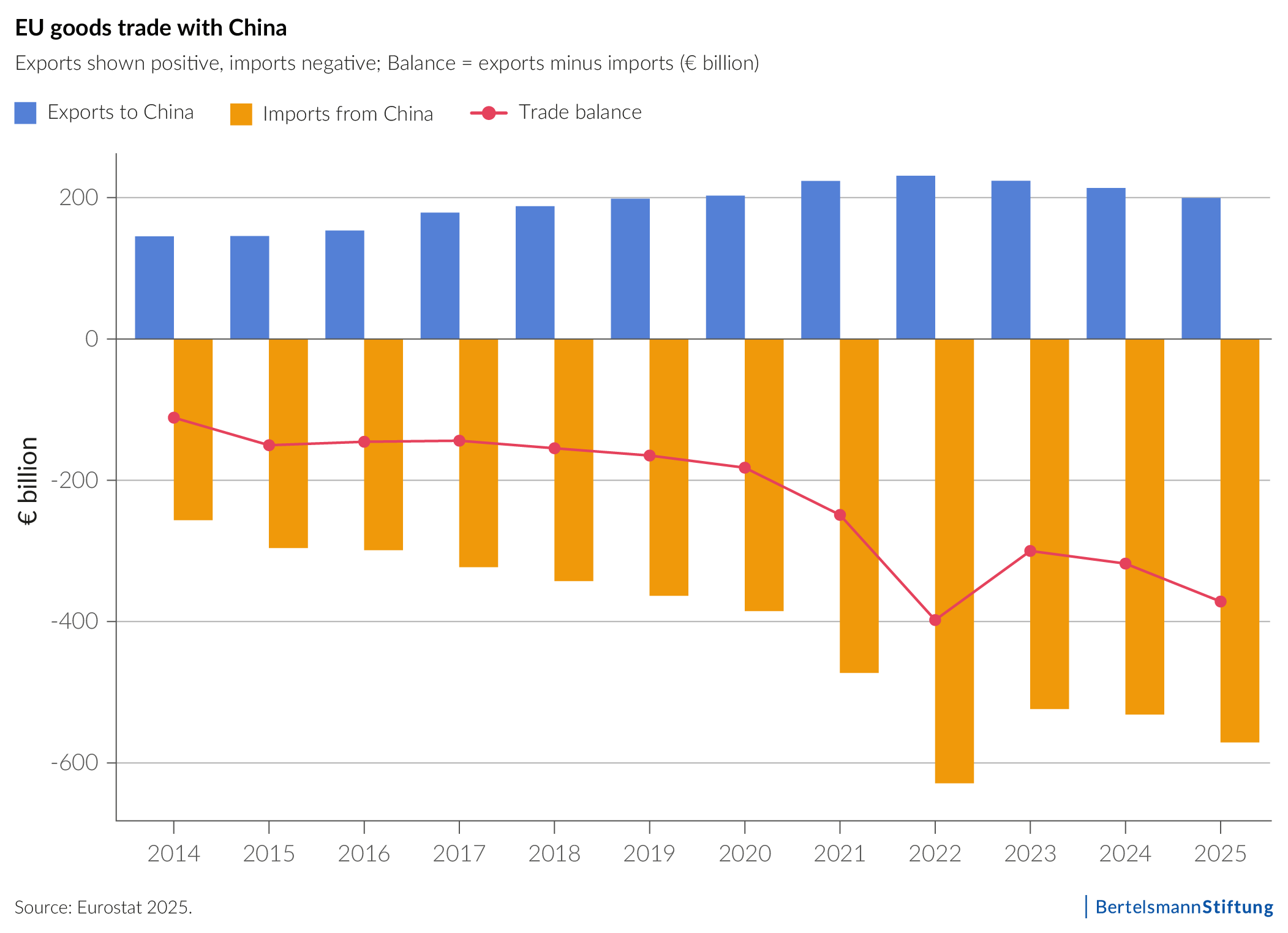
The EU’s trade deficit with China has grown consistently for the last decade and now amounts to around 2 percent of annual EU GDP (Figure 1). This trend has accelerated in recent years. Its root lies in the Chinese party-state increasing its strategic grip on the economy under the leadership of Xi Jinping. Under the ‘dual circulation’ framework, China has aimed to reduce reliance on imports in key sectors while bolstering exports. Partly as a result of this, European firms’ market shares in China have fallen. So-called ‘involution’ – or extreme price competition on the Chinese domestic market – strengthens the pressure to export in many sectors. It is fuelled by (mostly local) authorities’ unwillingness to let loss-making ‘zombie firms’ exit the market. China’s shrinking property market, combined with a banking system that responds to government goals, means investment in tradable production capacity is privileged over projects that serve domestic consumption. The renminbi is substantially undervalued. Estimates range from 12-21 percent (IMF) to around 33 percent (CFR). The CFR’s Brad Setser argues that China’s official statistics understate the country’s current account surplus, thus hiding the true degree of undervaluation. The weak renminbi means Chinese exports to the rest of the world are artificially cheap and imports into China are artificially expensive, promoting exports and stifling imports.
At the same time, China is doubling down on its mercantilist strategy. The 15th five-year plan, adopted in 2026, continues or even intensifies its industrial policies, especially in high-tech sectors. Meanwhile, internal demand in China remains relatively weak, especially in comparison with pre-Covid19 trends. Efforts to boost consumption have been unsuccessful. Household savings are considerably higher than in comparable economies, with a relatively weak social safety net, amid persistent financial instability. China’s financial system channels a substantial portion of these savings into manufacturing investments, especially as the real estate market continues to slide. The weak labour market contributes to slow growth in domestic demand. Exports are the way out of this malaise.
Changing China’s economic model would be long and painful, both for businesses who would lose some of the capital invested in export-oriented production, and for workers employed there. This could jeopardize political stability, which the Chinese government will avoid at all costs. Therefore, markets abroad will serve as the pressure valve for as long as this model is feasible for China, and notably, as long as export markets remain accessible.
Markets outside Europe are closing to Chinese products. The US is the most striking example, but Türkiye, Japan, Canada and Mexico have raised barriers to specific Chinese products like steel and EVs. The EU is therefore the last remaining large and wealthy economy that is still relatively open to Chinese exports. At the same time, China’s export boom puts pressure on the EU’s own export-oriented economic model – which may boost support for extremist political parties.
2 | From win-lose to mostly lose
In the past, member states’ differing interests have held back decisive trade measures against China. While France feared Chinese competition, for Germany and others the danger of losing export opportunities loomed larger. Germany’s politically influential automotive and machine tools companies are now rapidly losing ground to Chinese competitors, in China, the EU and on third markets. This could pave the way for a tougher response.
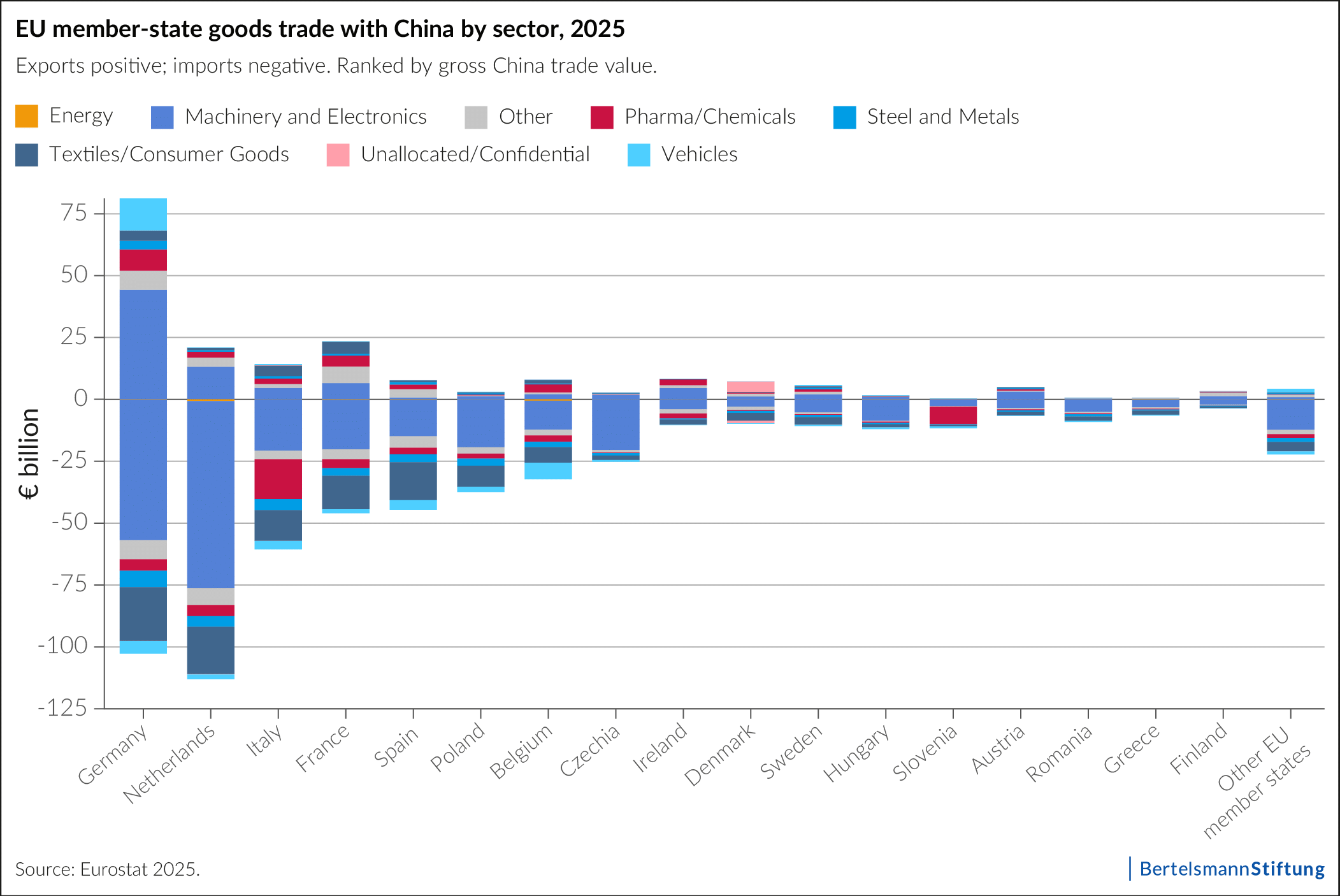
Within the EU, trade exposure to China differs substantially. In 2025, Germany was responsible for around 40 percent of EU exports to China and 18 percent of imports from China, according to Eurostat data (Figure 2). German machinery and electronics exports, a sector now heavily exposed to Chinese competition, account for more than 20 percent of EU exports to China. In other member states, exposure is concentrated in different sectors, for instance agriculture in France and textiles and consumer goods in France and Italy, especially luxury goods. But while direct exposure differs, German industry is highly interdependent with manufacturing in Central and Eastern Europe, creating the risk of knock-on effects through supply chains. And given the weight of the German economy within the EU, a broad shock to the country’s manufacturing base would inevitably cause issues for the bloc’s other economies.
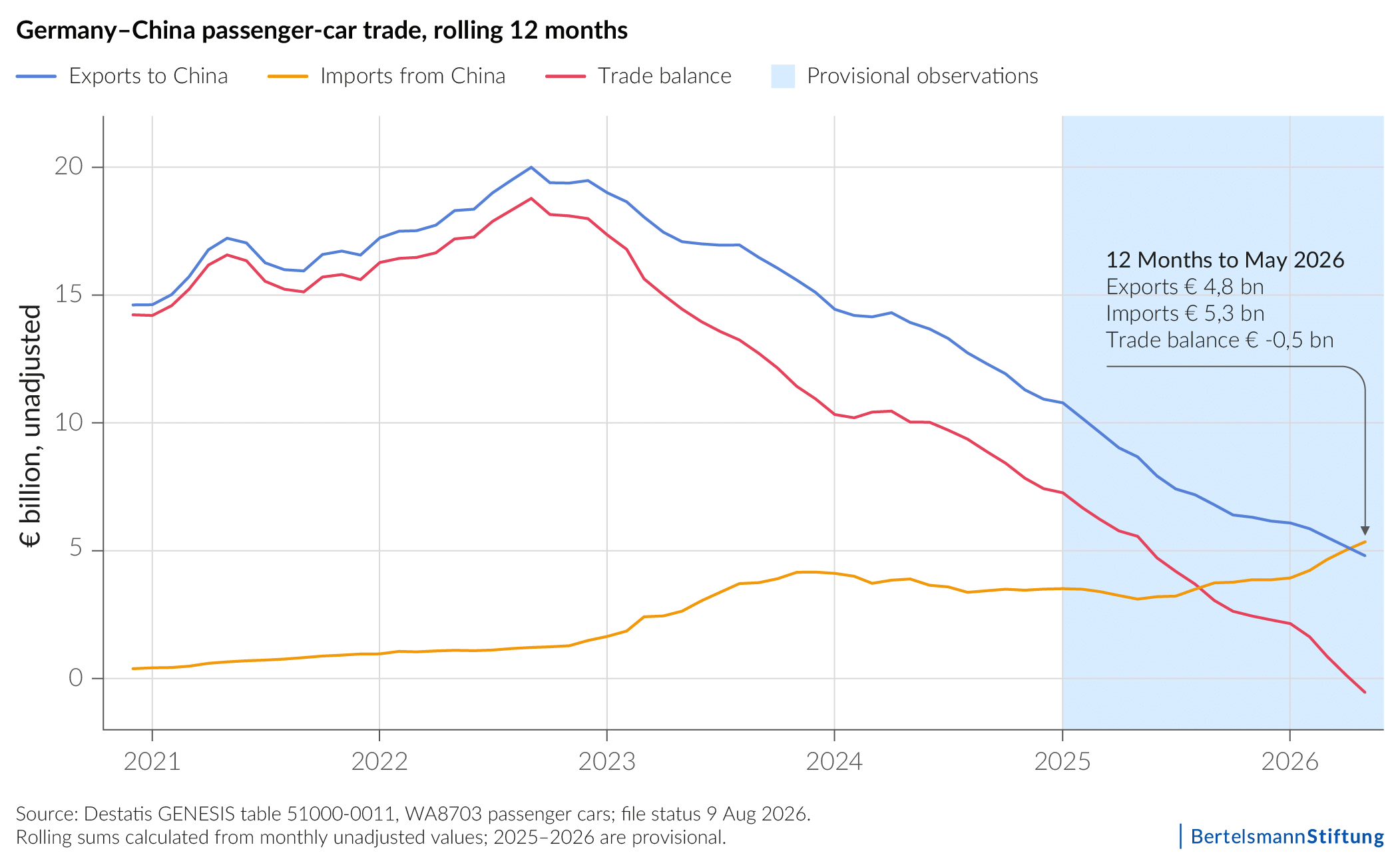
The industries that gained most from Chinese demand in previous decades are struggling now. German car exports to China have been declining rapidly in recent years, falling by two-thirds from 2022 to 2025. That is significantly more than the 24 percent decline in all German exports to China. In the year to May 2026, Germany imported more passenger cars from China than the other way around for the first time (Figure 3).
Exports to third countries are also under pressure: Due to China’s technological development, China is increasingly exporting the same advanced manufacturing products as many EU member states, and especially export-oriented Germany. In many markets and sectors, this leads to substantial displacement effects, even if Chinese competition is not the only factor contributing to European losses on export markets. In 2023, Chinese machinery exports had overtaken those of Germany by at least 50 percent in nearly 60 percent of markets worldwide. For France, the corresponding number is close to 100 percent. These dynamics have helped EU member states to converge on a tougher line on imports from China.
3 | The cost of action may be high. Consider the cost of inaction.
The EU is constrained by the threat of Chinese retaliation. China’s reaction could take multiple forms: on the import side, it could hit sensitive EU industries such as cars, wine and luxury goods with additional tariffs, exploiting the fact that EU member states’ exposure varies. Restricting exports in strategic goods on which the EU is dependent, like rare earths and products made with them, has become an instrument of choice for Chinese economic statecraft. Finding new suppliers of critical imports such as rare earths and permanent magnets therefore remains a pressing policy problem. Recent Chinese restrictions on exports linked to the Europe’s rearmament drive underline the urgency. In many cases, the EU’s initiatives to reduce dependencies are unlikely to bear fruit quickly, just as a trade confrontation with China becomes more likely. Investment remains insufficient, mining and processing projects take a long time to set up, and in many cases, Chinese suppliers’ lower costs still trump resilience considerations in corporate decision-making.
At the same time, inaction comes with economic and political costs. If current trends continue or accelerate, large parts of Europe’s industrial base are at risk and China’s supply chain dominance will continue to increase. That could undermine Europe’s prosperity, its social model and its ability to act geopolitically. Between 2019 and 2025, around 400,000 job losses in manufacturing in Germany alone were linked to Chinese competition, according to rough macroeconomic estimates.This trend is likely to further raise support for radical political parties. Beyond the immediate costs to workers and businesses, the erosion of Europe’s industrial base threatens its ability to produce and innovate, as rebuilding lost industries and regaining their know-how would come at a high cost. In a world where dependencies are weaponized, losing more of its industrial base would make the EU more vulnerable to economic coercion and less able to defend itself militarily.
As the EU’s China trade debate reaches a climax in the autumn of 2026, the three factors discussed above will drive decision-making: the direct economic costs of the second China shock, lobbying by European businesses with different interests, and the difficulty of weighing the cost of action against the cost of inaction.
The EU’s instruments
While the consensus has shifted in a hawkish direction, the EU’s course of action is yet to be defined. The task ahead: Effectively tackling the China shock to the EU’s manufacturing base while keeping costs as low as possible and managing the risk of Chinese retaliation. This requires a close examination of the EU’s trade toolbox: which measures can it use, what are their limitations, and where does the toolkit still have gaps?
Anti-dumping duties
Which problem is this instrument meant to solve?
Anti-dumping measures restrict imports with artificially low prices, below what’s called ‘normal value’: either at prices lower than in the domestic market or at prices below a good’s production and distribution costs. These measures might be useful in given ‘involution’ in the Chinese domestic market, where producers battle for shares in oversupplied markets with low prices.
How does it work?
The Commission starts anti-dumping investigations following complaints from the EU industry affected or, less frequently, on its own initiative. The investigation determines whether there is dumping in a specific product category using corporate data. As domestic prices for inputs are heavily distorted in China, the Commission frequently relies on prices from other representative markets to calculate a product’s normal value. The next step is to determine whether the dumping causes injury or a threat of injury to EU industry, for instance through reduced sales, profits or employment. For infant industries, injury can be forestalled investment or lost contracts, compared to a counterfactual scenario. Finally, the Commission examines whether countermeasures would be in the EU’s interest. During the investigation, the Commission can impose provisional measures. It can impose final measures unless a qualified majority of member states opposes them. The maximum level of anti-dumping duties is either the dumping margin, i. e. the difference between the product’s actual price and the normal value, or the amount needed to offset the injury to European industry, depending on which is lower. The highest duty rate is applied to Chinese companies that do not co-operate by providing price data. This problem is getting worse as the Chinese government imposes more restrictions on sharing business data with foreign entities.
Would this work?
Anti-dumping duties offer a price-based instrument that can be used without needing to demonstrate the specific mechanics of unfair price advantages. The Commission’s ability to compare prices with representative markets lowers the evidentiary burden. At the same time, duties generally don’t fully offset the dumping margin. As individual measures target specific products, anti-dumping becomes less effective when product markets are highly fragmented and products can easily be transformed and then imported under a different tariff line. As measures only provide relief for single product categories instead of entire sectors and supply chains, they fall short of the scale and breadth of Chinese competition.
Anti-subsidies duties
What problem is this instrument meant to solve?
State subsidies, such as grants, tax breaks and access to cheap credit give Chinese firms cost advantages over European ones. This helps Chinese companies producing for domestic and foreign markets – sometimes even including EU firms with plants in China – and hurts European companies that don’t benefit from the same subsidies. An OECD study has found that Chinese industrial firms were granted three to eight times more state support than firms based in the OECD between 2005 and 2024, mainly in the form of subsidised loans. Anti-subsidy duties are designed to offset these cost advantages on the European market and create a level playing field. They only address subsidies given to particular sectors or companies in particular locations.
How does it work?
As with anti-dumping duties, the Commission investigates following complaints from the EU industry affected or on its own initiative (again, less frequently). The investigation follows the same pattern: whether Chinese firms have benefitted from subsidies, whether European firms have been harmed, and whether countermeasures would be in the Union interest. The maximum level of countermeasures must equal the amount of the subsidy. Provisional measures can be applied, and a qualified majority of member states must oppose the final measures to stop them being enacted. Anti-subsidy investigations can also cover subsidised inputs along supply chains; for instance, the EU’s investigation into Chinese electric vehicles also considered batteries and battery components.
Would this work?
Anti-subsidy duties potentially allow for higher tariffs than anti-dumping measures, especially where they capture subsidies to a product’s inputs that contribute its unfair cost advantage. They require more evidence than anti-dumping duties as the Commission needs to demonstrate specific cost advantages due to government support, so investigations can take longer and take up more administrative resources. Politically, anti-subsidies investigations provide a clearer link between China’s industrial policy and unfair cost advantages than anti-dumping duties, so they provide more transparency, to the extent that access to data is possible. Anti-subsidies measures are particularly helpful for high-profile, strategic industries like electric vehicles.
Safeguards
What problem is this instrument meant to solve?
Safeguards are meant to tackle sudden and unexpected changes in imports. As such, they aren’t tools to address unfair trade practices, but rather domestic industries’ difficulties in adjusting to import shocks. They are mainly used for sectors which are either sensitive, such as steel, or experience sudden global supply variation, such agricultural products, and can cover broader product categories than anti-subsidies or anti-dumping measures. This is relevant to the China trade debate, as distortions often go beyond single product categories, for instance in steel or chemical products.
How does it work?
When compared to anti-dumping and anti-subsidies measures, safeguards are much easier to implement, because the legal requirements are less strict. There is no need to prove unfair trade practices. Rather, safeguards can be imposed when a surge in imports is linked to harm to EU producers, e. g. decreasing production, lower capacity utilization, shrinking market shares or a decline in employment. When this has been determined, the EU Commission can propose different measures: additional tariffs, tariff rate quotas (limits to the volume that can be imported before higher tariffs kick in), or overall quantitative limits. These measures are adopted when a qualified majority of member states approves them – unlike anti-dumping and anti-subsidies measures, where the absence of a qualified majority against a specific measure is sufficient.
Would this work?
Safeguards are much faster to use than other instruments because the burden of evidence is lower. They can cover several related product categories with one investigation, unlike other trade defence instruments. However, they are a blunt instrument: as safeguard measures apply to all of the EU’s trading partners indiscriminately, they cannot be targeted on Chinese imports, and would likely create tensions with other trade partners, as did the EU’s 2026 steel measures. Safeguards are therefore most effective in two cases: where there are global overcapacities, as with steel, and where EU producers mainly compete with Chinese imports and other trading partners would hardly be hit by them.
Calibrating trade measures: The Union interest test
To calibrate trade measures, the EU’s trade instruments incorporate ‘Union interest’ as a criterion, balancing producers’ concerns with other factors such as companies that use imported components and consumers. Measures are only imposed if this evaluation is positive. Electric vehicles are an example of this trade-off: Tariffs shield EU manufacturers and employment but increase consumer prices and may reduce the availability of cutting-edge technologies on the European market.
The Anti-Coercion Instrument (ACI)
What problem is this instrument meant to solve?
The Anti-Coercion Instrument is designed to respond to trade or investment measures by a third country to influence the EU’s or a member state’s actions. Its goal is to better equip the EU and its member states against the weaponisation of economic relations by deterring adversaries before they engage in coercion or, if this fails, pressuring them to stop.
How does it work?
The Commission examines whether specific measures amount to economic coercion and submits its findings to the Council. If a finding of coercion is confirmed, the Commission engages in consultations with the third country concerned. If these are unsuccessful, it proposes countermeasures, which have to be confirmed by a qualified majority of member states. The ACI allows for a broad range of measures, including tariffs, trade restrictions, restrictions on services, intellectual property and investment. This gives the EU flexibility in designing its retaliation, based on an adversary’s specific vulnerabilities and the desired level of escalation. The ACI only offers a procedural framework, without predetermining specific measures, which makes the instrument more political than the others. So far, the ACI has never been applied since its establishment in 2023, neither in the form of investigations nor retaliatory measures.
Would this work?
The ACI is the EU’s prime instrument for managing geoeconomic confrontation. As it is highly flexible and allows for a broad range of measures, national politicians must be supportive. Some member states believe that it would lead to escalation with China, which is why it hasn’t been used. The ACI’s effectiveness depends on two factors: the extent of China’s dependencies on the EU, which would allow the EU to impose costs on China, and China’s willingness to absorb these costs and not retaliate.
The International Procurement Instrument (IPI)
What problem is this instrument meant to solve?
While the EU’s large public procurement markets are mostly open to foreign suppliers, China, among other countries, places many restrictions on foreign bidders in procurement, both formally and informally. The International Procurement Instrument is meant to level the playing field, excluding companies from countries that exclude EU companies.
How does it work?
The Commission investigates public procurement restrictions in a third country, either on its own initiative or following a complaint from industry or a member state. If the Commission finds that EU companies are discriminated against in procurement and countermeasures would be in the Union interest, it then proposes proportional restrictions on procurement bids from the third country. That can either be total exclusion from public procurement or a ‘score’ penalty in procurement procedures. The measure is adopted if there is no qualified majority of member states against it. The IPI has only been applied once, with regards to Chinese medical devices, excluding them from EU public tenders above €5 million.
Would this work?
While the role of public procurement increasingly comes into focus in economic policy, for instance in the proposed local content requirements under the Industrial Accelerator Act, the IPI’s added value seems limited so far, as it has only been used once. This may be due to the complexity of the procedure. The Commission has launched a review of the IPI in September 2026.
Uncharted territory – proposals for new instruments
As pressure on EU manufacturing from Chinese competition continues to increase, the EU is now debating new instruments to close existing gaps in the toolkit: to be better equipped for geoeconomic confrontation with China, to spread the costs of that confrontation within the EU and to address market distortions that fall through the cracks of conventional anti-dumping and anti-subsidies duties.
‘A new instrument for decisive and systemic reaction’
What problem is this instrument meant to solve?
If the EU decides to impose broad trade restrictions, Chinese retaliation is likely, but the EU lacks an instrument for fast and hard reactions to this. In a joint position paper, the French and German governments asked the Commission to propose an instrument to tackle severe and systematic distortions.
How could it work?
The instrument could be broadly similar to the Anti-Coercion Instrument or the ‘European 301’ discussed below. The Commission would propose trade restrictions, which would then be voted on by a committee of member state representatives. To make the instrument easier to use, these restrictions would be adopted by reverse qualified majority, passing if there is no qualified majority against them. The Franco-German position paper underlines the need to be able to react quickly. As with the ACI, the range of available countermeasures could be quite broad. Measures under this new instrument would also be subject to the Union interest test (see p. above).
Would this work?
As the discussion around this instrument is still in its early stages and there is no fully-fledged concept yet, it is difficult to assess its effectiveness. Some of its limitations may be similar to the ACI’s, especially the need for politically calibrating the measures and its reliance on the EU’s capacity to sustain geoeconomic conflict. At the same time, an instrument operating under the reverse qualified majority rule would be much easier to use, enhancing the EU’s ability to act.
EU ‘Section 301’
What problem is this instrument meant to solve?
The EU’s existing trade defence instruments are built for product- or company-specific distortions. But China’s cost advantage is linked to certain systemic distortions, such as capital controls, a state-directed financial system, an undervalued currency and preferential treatment for Chinese firms in many administrative procedures. An EU ‘Section 301’ could address the systemic factors behind Chinese mercantilism and come in where existing tools fall short.
How could it work?
This new instrument would be modelled on Section 301 of the 1974 Trade Act in the United States. Following complaints by industry or member states, the Commission could launch an investigation into other countries’ trading practices and then propose countermeasures. As with other trade defences, these measures would have to be approved by member states, for example by a qualified majority in favour. This type of instrument would give the Commission broad discretion in the conduct of investigations.
Would this work?
Such a tool could theoretically fill some of the gaps left in the EU’s current toolkit and do so in a flexible manner. But the political hurdles are high, as member states will be hesitant to give the Commission far-reaching discretion over trade investigations. There are legal hurdles: WTO rules set narrow limits on members’ trade defence instruments, and many of the potential use cases would not be covered by these rules. Unlike the US, the EU and China are parties to the Multi-Party Interim Arrangement, which would allow China to challenge such measures at the WTO. That would further contribute to political hesitancy within the EU.
Diversification instrument
What problem is this instrument meant to solve?
In many critical sectors, such as rare earths, different forms of IT equipment and solar panels, the EU depends on imports from China, with dependencies sometimes reaching close to one hundred percent. China can weaponize these dependencies through export controls. At the same time, when Chinese firms and European firms producing in China have cheaper and more reliable access to these inputs, this also gives them an additional advantage over their competitors or – in the case of European companies, their European production base. Until now, the EU has not diversified much from China, and in some sectors, dependency has even increased. This is also linked to structural market issues, especially in many critical materials: new processing plants have big upfront investment needs, markets remain highly volatile, and China is able to use its dominant market position to undermine potential competitors. Both alternative suppliers and buyers thus often face a first-mover disadvantage.
How could it work?
There are several options for the design of a diversification instrument. On the firm level, in certain critical sectors, businesses could be required to diversify their sourcing of inputs such as raw materials. Diversification could also be incentivized through tariff rate quotas, with higher tariffs kicking in as soon as a certain threshold of imports has been passed. In this way, a diversification instrument could support alternative suppliers in sectors where China dominates. Notably, it could forestall China’s attempts to strangle emerging competitors by flooding global markets with cheap supplies.
Would this work?
A well-designed diversification instrument could contribute to decreasing China’s geoeconomic leverage through critical dependencies. It would not directly improve EU firms’ price competitiveness. Depending on the design of the instrument, it may create administrative costs; in any event, it will increase the prices of some inputs. Its effectiveness depends on more investment in alternative supply chains, for instance through member states’ raw materials funds and specific subsidies and price guarantees for alternative suppliers.
Solidarity instrument
What problem is this instrument meant to solve?
Member states have substantially different exposures to a trade conflict with China. In the past, China has leveraged this by targeting vulnerable industries with tariffs and other restrictions, for instance through anti-dumping probes against EU spirits exports in the context of the EU’s tariffs against Chinese EVs. This pressures EU governments to break away from joint EU positions, leaving the bloc less able to defend its collective interests. Some EU measures, such as new export controls, would also come with a cost for the industries concerned, for example semiconductors or aviation.
How could it work?
An EU solidarity instrument would offset some of the costs of a trade war with China through compensation. This instrument could offset demand shocks in member states that lose exports to China, but would be ineffective against supply shocks generating shortages, such as new export restrictions on rare earths and permanent magnets. The scale of compensation is a key factor. The current EU budget, running until the end of 2027, has little room or flexibility for more spending. The next budget is unlikely to be much larger than the current one, which stands at around one percent of EU GDP. Growing needs in other budget lines – not least, defence – further constrain the space for compensation. In consequence, member states would have to cover for the cost in another funding line.
Compensation schemes need to be carefully designed. They should account for the problem of moral hazard: for many companies, business with China has been highly profitable, but it has also created considerable economic risks. When these materialize, public intervention should cushion them only where there is a clear rationale. This could take the form of transition support for workers and businesses which are the most affected, offering unemployment payments and retraining.
Would this work?
If the EU enters an intense trade confrontation with China, compensation would make it easier to maintain a strong common position, and to use the ACI if needed. The policy discussion is still in its early stages. An instrument based on the EU budget would fall short because there is little unallocated money in the current one and the next one will start in 2028. This means that EU member states need to prepare to step in.
Investment conditionality
What problem is the instrument meant to solve?
Tariffs and other trade barriers encourage Chinese companies to shift production to the EU. However, there is growing concern that Chinese investment may not generate much value-added in Europe, as Chinese firms may rely on Chinese inputs and Chinese personnel while preventing the diffusion of intellectual property. Within the Industrial Accelerator Act, the Commission proposes adding conditions to foreign direct investment in strategic sectors in order to ensure that these investments benefit European economies.
How could it work?
Under the Commission’s proposal for the Industrial Accelerator Act, foreign direct investments above €100 mio. in four strategic sectors – batteries, electric vehicles, solar PV technologies and critical raw materials – would be subject to conditionality. Investments would need to meet four out of six criteria, which impose limits on foreign ownership, require joint ventures with EU companies, and ensure technological transfer, research and development within the EU, employment in the EU and using EU suppliers. The employment criterion would need to be fulfilled in all cases. The conditionality would apply only in cases where the country of origin of the investment has a share of global capacity of more than 40 percent in the sector concerned; effectively, this would only affect Chinese investments.
Would it work?
Investment conditionality can complement tariffs and other trade barriers, as it ensures local value-added in employment and technology transfer when Chinese companies seek to vault over the EU’s trade barriers by investing in Europe. Critics fear negative effects on investment and additional administrative burden. This can be mitigated both by the design of the instrument, which is tailored to China, and its scope limited to few critical sectors.
Local content requirements in public procurement and support schemes
What problem is the instrument meant to solve?
Some European industries are currently suffering from weak demand, both from Chinese competition and weaker European domestic demand. This creates a negative feedback loop: weak demand prevents businesses from growing, which puts further downward pressure on their price competitiveness as scale economies are curbed. At the same time, Chinese providers often win public procurement contracts due to their ability to offer extremely low prices. This is a challenge both for emerging industries and incumbent carbon-intensive industries that need to cut emissions.
How could it work?
Under the Commission’s proposal for the Industrial Accelerator Act, European production could be preferred in public procurement and support schemes in some industries of the future such as electric vehicles and wind turbines, but also energy-intensive industries like paper and glass, either by shares of total added value or specific requirements for certain components. This could exclude goods made in China or with substantial shares of Chinese inputs. The extent to which the EU’s other trading partners should be included is still under discussion, with the Commission proposing to include the EU’s FTA partners with procurement agreements, and parties to the WTO Public Procurement Agreement.
Would this work?
Local content requirements can help channel public demand to European companies and leverage public funds for industrial policy. But there are drawbacks. For producers, especially those with complex supply chains, the administrative burden could increase substantially. Prices for public procurement in the sectors concerned would also increase. This demands a targeted approach focusing on industries with high growth potential or strategic importance.
What the EU should do
The EU has a broad range of trade tools at its disposal, but finding the right response to growing Chinese competition depends on the way it uses them. Three points are key to this:
Upgrade what you have and use it now
The China shock is happening now, but legislation is slow. New measures such as a solidarity instrument or a ‘European 301’ may close some of the gaps. But most will take years to design and adopt, and even longer to implement – and others, such as the diversification instrument, would address the effects of the China shock only indirectly.
A lot of what the EU needs is already in place, waiting to be used more effectively and assertively. Small adjustments can be achieved in the short term. This could include, for instance, making it more difficult for companies to circumvent EU tariffs by routing their goods through third countries, loosening the lesser-duty rule for anti-dumping measures and broadening the product scope that can be covered with single anti-dumping or anti-subsidy investigations, as proposed by five EU member states in May 2026. Personnel is another key factor: While the workload of DG TRADE has increased substantially in recent years, both through the addition of new instruments and an increasing number of cases in trade defence, the DG’s headcount hasn’t kept pace with the additional tasks, growing from 699 in 2020 to 732 in 2026. Increasing the staff assigned to trade defence at the Directorate G (Trade Defence) of DG TRADE within the Commission would allow for faster investigations, leading to more effective protection for European industries.
Look for landing zones
Trade tensions between the EU and China result from structural factors. Notably, China is unwilling to substantially boost consumption and reduce exports in the foreseeable future. This means that some disagreement is inevitable. Both sides have an interest in managing that confrontation through engagement. For the EU, next to more robust trade defence measures, this means defining more concrete landing zones short of open trade, free movement of capital and a full level playing field. What degree of market openness vis-à-vis China is desirable and sustainable given the EU’s own economic structure? This should translate into concrete targets and demands which, even if unmet by the Chinese side, would anchor the discussion.
Embed the China trade measures in a holistic growth and competitiveness strategy
The current debate on the EU’s economic policy is split in two camps, one emphasizing China’s contribution to Europe’s malaise and the other focusing on domestic factors like bureaucracy, high labour costs and energy prices as well as a fragmented internal market. To deal with the current challenges successfully, the EU needs to combine both intelligently. This is especially urgent in case of a trade escalation with China. Even if imports from China face higher tariffs in the EU, that will not be the case forever – and EU tariffs won’t contribute to EU firms’ competitiveness on third markets that do not impose additional tariffs on China. European manufacturers will need to adapt quickly to be able to compete on European and global markets again. The single market agenda is key to achieving this: Europe needs a market that helps rather than hinders companies to grow. Today, too often, legal differences between member states, a largely national capital market and high energy prices hamper the growth of European firms so they achieve economies of scale. Member states should more urgently pursue the single market agenda with ambition and put national sensitivities aside. In an increasingly power-based trading system, the EU needs to throw its full weight behind protecting and promoting the single market as its greatest asset. Therefore, internal market reform should be top of the agenda.
The EU’s trading relationship with China has become increasingly unsustainable, and even in member states that used to be hesitant, like Germany, political momentum to tackle this is building up. To do so, the EU’s existing tools can go a long way; they should be used and upgraded where necessary. At the same time, the EU should keep negotiating with China – without expecting large-scale adjustments – and define its own political landing zones. Finally, any set of measures should be designed in the larger context of the EU’s economic policy goals: as part of a broader strategy to ensure growth, competitiveness and prosperity in the future.
References and footnotes can be found in the PDF version of this policy brief.
About the author
Etienne Höra is a project manager focusing on the EU’s foreign economic policy in a geoeconomic age. His areas of expertise include trade policy, economic security and EU-China relations.
Jake Benford, Brandon Bohrn, Lucas Resende Carvalho, Claudia-Dominique Geiser, Christian Hanelt, Anna Heckhausen, Etienne Höra, Cora Jungbluth, Miriam Kosmehl, Helena Quis, Torben Schütz, Peter Walkenhorst
Lucas Resende Carvalho, Elisabetta Cornago, Etienne Höra, Philipp Jäger
9. December 2025
Subscribe to our newsletter
Like what you're reading? The best way to keep up with our work is to subscribe to our newsletter.
Our Europe briefing with editorials by Lucas Guttenberg and Malte Zabel lands in your mailbox twice a month, with information on our events, publications and the latest updates from our experts.




Write a comment