Fund or Fumble – How to Make the European Competitiveness Fund Work
The proposed European Competitiveness Fund (ECF) represents a material shift in both the design and governance of EU industrial policy. By consolidating fragmented instruments, concentrating resources within strategic policy windows, reinforcing annual work programmes and bringing grants and financial instruments together under a single framework, the ECF could become the anchor of a more coherent industrial policy at European level. Yet crucial elements of the ECF proposal remain politically contested. Fault lines are emerging over the fund’s overall scale, the balance between merit-based allocation and geographical distribution, the depth of strategic prioritisation and the scope of European preference provisions. At the same time, critical governance interfaces – notably between Horizon and the ECF, and between grants and financial instruments – require clearer definition. The ECF must also strike a credible balance between flexibility and effective oversight. Against the backdrop of intensifying negotiations, this paper assesses the European Commission’s proposal and advances recommendations to ensure that the ECF evolves into a genuinely transformative instrument of industrial policy rather than a rebranded consolidation of existing funding streams.
1. Introduction
The European Competitiveness Fund (ECF), proposed by the European Commission in July 2025, has entered a decisive phase of negotiation. In December, the Danish Presidency tabled an initial negotiation box alongside a draft Council position, placing the file at the centre of discussions on the 2028–2034 Multiannual Financial Framework (MFF). The coming months will determine whether the EU establishes a credible vehicle to finance industrial policy and innovation, or simply rebrands and repackages existing programmes.
At present, EU support for innovation, industrial capabilities and strategic investment is dispersed across a dense landscape of instruments, each operating under distinct rules, governance arrangements and reporting requirements. As Mario Draghi has argued, such fragmentation dilutes strategic direction and hampers the Union’s ability to reallocate resources swiftly in response to technological disruption or geopolitical shifts. The ECF is designed to address these structural weaknesses by consolidating programmes within a single framework, concentrating funding in a limited set of policy windows and enabling more responsive programming across the seven-year budget cycle.
Yet the features that give the ECF its transformative potential are also the source of political contention. In parallel, several design elements require further clarification – in particular the interface with Horizon Europe, the governance of built-in flexibility and the operational relationship between grants, procurement and financial instruments.
Seven principles could guide Member States and the European Parliament as negotiations on the ECF intensify:
Protect scale: Resist cuts to the ECF. Should reductions prove unavoidable, ensure they are proportionate to adjustments elsewhere in the MFF.
Hold the merit line: Keep allocation under the ECF fully merit-based. Pursue cohesion objectives through the first MFF heading rather than importing a distributive logic into the ECF.
Maintain strategic focus: Preserve a targeted approach that concentrates support on a limited number of strategically selected technologies with high innovation potential. Attach clear transformation and decarbonisation conditionalities to support for hard-to-abate industries.
Anchor value in Europe: Equip the ECF with flexible European preference instruments to reduce critical dependencies where they matter most.
Clarify the links between Horizon Europe and the ECF: Retain curiosity-driven research within Horizon and industrial development support within the ECF to avoid blurred mandates. Connect both through clearly defined transition points.
Reconcile flexibility with control: Promote flexibility through more responsive annual work programmes, while strengthening Member State and independent expert input, transparency and democratic scrutiny.
Use the right tool for the job: Deploy the appropriate support instrument at each stage of the investment cycle and avoid privileging financial instruments by default. Operationalise the ‘single toolbox’ so that projects can move coherently between the ECF’s grant-based and financial components.
2. The ECF at a glance: what it does and what it changes
With the ECF, the Commission proposes a far-reaching restructuring of how the EU finances industrial policy and innovation. Together with the successor to Horizon Europe, the ECF sits at the core of one of only three principal pillars of the next MFF: Pillar 2, dedicated to competitiveness. In EU policy discourse, competitiveness has evolved into an umbrella term encompassing a cluster of interlinked objectives: raising productivity, strengthening economic resilience and strategic autonomy in the face of external shocks, and accelerating both the digital and green transitions.
The ECF is the Commission’s direct response to the structural and financial weaknesses weighing on the EU’s competitiveness, as identified in Mario Draghi’s report. The central diagnosis is that funding for industry and innovation remains fragmented across multiple programmes and guided by an incoherent mix of partially overlapping objectives. In practice, this fragmentation gives rise to three persistent shortcomings that the ECF seeks to remedy:
First, fragmented funding dilutes strategic direction: resources are dispersed rather than concentrated on clearly defined industrial and technological priorities.
Second, programme-specific rules and procedures create complexity: each instrument operates under its own governance and reporting requirements. For beneficiaries, particularly SMEs and smaller firms, the system is difficult to navigate. Administrative burdens raise entry barriers and impede the scaling of promising projects.
Third, the existing architecture lacks flexibility: funding priorities are largely pre-determined and adjustments require time-consuming procedural steps. This constrains the EU’s ability to respond swiftly to emerging technologies or shifting geopolitical conditions.
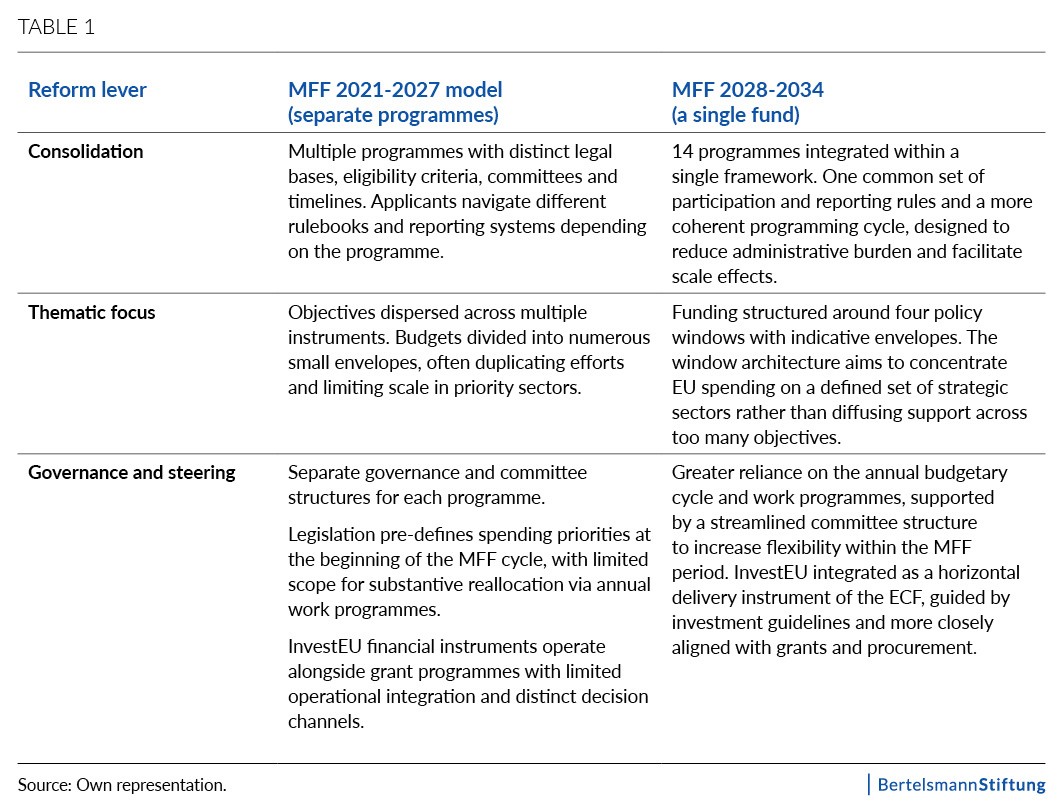
The ECF would consolidate funding within a single framework and organise expenditure across four policy windows and one cross-cutting window. The intention is to simplify access while enabling more purposeful strategic allocation. At the same time, the proposal concentrates operational responsibility within a limited number of Directorates-General and moves decision-making closer to the Commission through more flexible programming instruments. In doing so, the Commission aims to strengthen its capacity to react to shifting challenges and adjust funding over time.
2.1 What is new: three structural reforms that matter
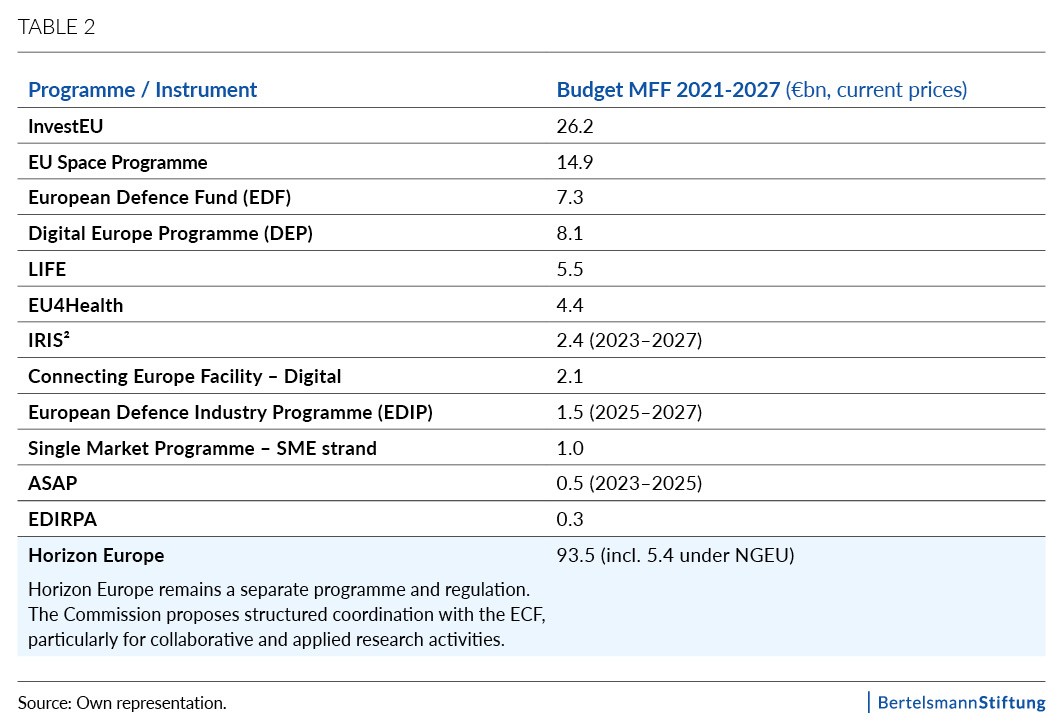
2.2 The proposal consolidates the following programmes under the ECF
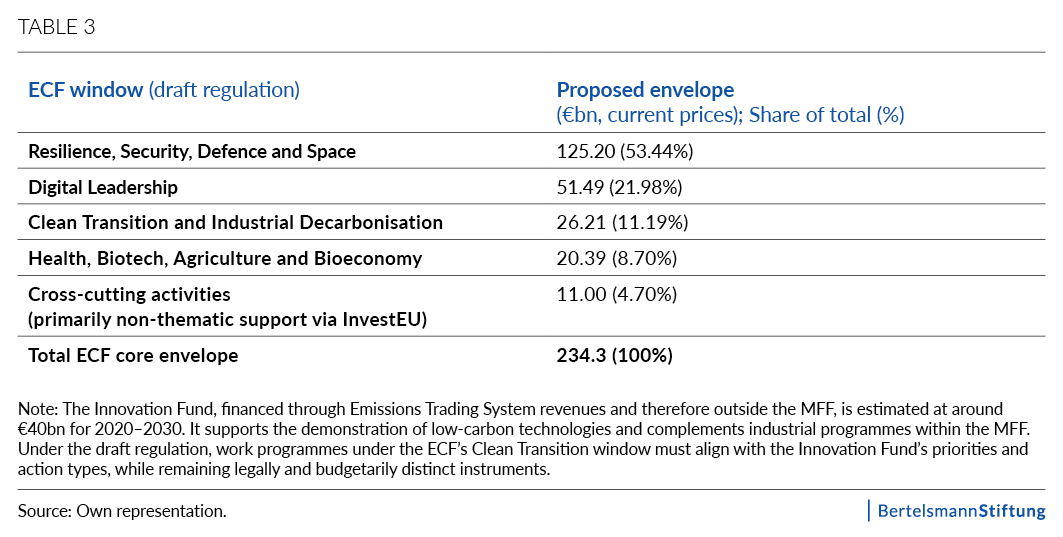
2.3 How the ECF is structured – and why the headline numbers are confusing
The Commission proposes €409 billion in current prices for research and competitiveness over 2028–2034, compared with roughly €168 billion allocated to corresponding programmes in 2021–2027. At first glance, this suggests a dramatic expansion. In reality, the figure aggregates three distinct layers:
the ECF core, fully governed by the ECF regulation (€234.3bn)
a Horizon competitiveness component, legally separate but operationally aligned with the ECF and its priorities (around €68bn),
the remaining Horizon Europe envelope, which remains outside the ECF’s governance framework (around €107bn).
In its public communication, the Commission frequently presents the €409bn figure as if it were the ECF’s budget. This is potentially misleading. The total combines the core ECF allocation with the proposed Horizon Europe envelope, even though Horizon is intended to remain a distinct programme with its own legal basis and governance structures.
While the draft regulations envisage close coordination between the two instruments, the operational interface remains insufficiently specified. Within Horizon Europe, the Commission proposes a substantial ‘Competitiveness’ component dedicated to collaborative and applied research and innovation. This segment would be explicitly aligned with the ECF’s policy windows and programmed through ECF work programmes. In practice, this would create an effective envelope of approximately €302 billion for the ECF and aligned programmes.
The ECF consists of four thematic windows and one cross-cutting window.
2.4 Governance shift under the ECF: what changes compared to the current model
The ECF proposal recalibrates the way EU competitiveness and research and innovation funding is steered. Compared with the current model, exemplified by Horizon Europe, it allows greater adjustment within the MFF period rather than fixing priorities and delivery instruments at the outset. The reform rests on four pillars: more centralised steering, more flexible work programmes, horizontal integration of financial instruments, and additional flexibility provisions.
a) Centralised steering and reduced fragmentation
Under the current model, EU R&I and competitiveness funding is spread across numerous programmes administered by different thematic Directorates-General (DGs). Several instruments pursue closely related or overlapping objectives yet operate under separate administrative structures, work programmes, committee systems, and participation rules. The result is parallel governance chains that complicate coordination and dilute strategic direction across funding streams.
The ECF proposal addresses this fragmentation by consolidating a range of instruments within a single framework. Strategic oversight is concentrated in a limited number of lead DGs, in particular DG GROW and DG BUDG. The intention is to reduce administrative dispersion and establish a clearer centre of responsibility for competitiveness funding.
b) A larger governance role for work programmes
Under the current model, programming is both fragmented and comparatively rigid. In programmes such as Horizon Europe, strategic priorities are largely determined at the outset of the budget cycle. The basic act establishes the pillars, dedicated sub-programmes, financial envelopes, and a detailed spending architecture. Work programmes play a primarily operational role, translating these pre-defined priorities into concrete calls and procurement procedures. The scope for substantive strategic adjustment during the MFF period is limited. In addition, work programmes are typically multiannual, covering two to three years, which further constrains responsiveness.
The ECF proposal recalibrates this balance. While the basic act continues to set overarching objectives, define policy windows, and establish indicative envelopes, it does not pre-allocate resources across a wide range of granular spending categories. Instead, decisions on the composition, scale, and sequencing of priorities within each window shift to the work programmes. These are adopted on an annual basis, particularly for grants and procurement, allowing priorities to be reviewed and adjusted throughout the MFF cycle. In this model, the fund is not fully specified at the beginning of the period but takes shape progressively through iterative programming.
As a result, the annual budget procedure would acquire greater political weight. Approval of appropriations would no longer amount to endorsing a largely fixed multiannual architecture but would, in effect, validate meaningful programming choices.
Work programmes are adopted by the Commission through implementing acts. The procedure attached to these acts represents a central point of divergence between the Commission proposal and the Danish Presidency’s draft:
Under the Commission proposal, most work programmes follow the advisory procedure. Member States deliver a non-binding opinion, while the Commission retains final decision-making authority. The examination procedure, which requires qualified majority approval, applies only in politically sensitive areas such as defence.
The Danish Presidency draft, by contrast, extends the examination procedure to all policy windows. Member States thus hold a binding vote on each work programme and could, in practice, block its adoption. Through this approach, the Council seeks to preserve stronger control over programming decisions, albeit at the expense of the agility embedded in the Commission’s original design.
c) Horizontal integration of financial instruments
Under the EU’s current funding model, grants and InvestEU financial instruments operate largely in parallel. This institutional separation constrains efficiency and weakens continuity between early-stage support and later-stage investment.
The ECF proposal integrates financial instruments horizontally across all policy windows. InvestEU no longer functions as a separate instrument alongside the fund but instead serves as a delivery tool available within each policy window.
The proposal requires at least €17 billion in provisioning from the ECF budget for the InvestEU Instrument (Art. 21(4)). This includes €10 billion from the cross-cutting envelope, with the remaining amount of approximately €7 billion or more contributed from the four thematic windows via their respective work programmes. The maximum budgetary guarantee under InvestEU amounts to €70 billion, provisioned at a rate of 50%. In practice, this means that only half of the InvestEU guarantee corresponds to committed ECF budget resources. The remaining share constitutes a contingent liability that is called upon only in the event of defaults.
From a governance perspective, integration operates through a three-tiered mechanism:
Investment guidelines adopted by the Commission through delegated acts define strategic priorities and eligibility criteria for financial instruments.
Implementation is carried out by entrusted partners, primarily the European Investment Bank and national promotional banks, either under ECF guarantee agreements for budgetary guarantee-backed operations or through direct agreements for other instruments such as equity.
A budgetary link is established through the work programmes, which can channel resources from any policy window into InvestEU. This creates a formal bridge between grants and procurement on the one hand and financial instruments on the other, even though investment guidelines and work programmes remain institutionally distinct governance tracks.
d) Additional flexibility provisions
Beyond these structural design choices, the draft regulation includes further flexibility provisions that expand the Commission’s discretion during implementation.
Provisioning flexibility: The Commission may adjust the provisioning rate for financial instruments, though not for grants, and modify the maximum amount of the budgetary guarantee by up to 20%.
Intervention mechanism: In ‘urgent situations of strategic importance’, the Commission may redirect and accelerate the use of existing ECF resources. While such situations are framed as temporary, the draft does not define their duration or establish explicit exit criteria.
Budget timing backstop: If a work programme has not been adopted by 1 October of the year preceding implementation, the Commission must adopt it by 15 October through an immediately applicable implementing act. This mechanism is intended to prevent procedural delays from obstructing budget execution.
2.5 European preference in the ECF: what it is and how it is operationalised
A genuinely new element in the ECF proposal is the codification of a structured ‘EU preference’ toolbox that can be activated for individual award procedures. EU-preference conditions do not apply automatically across the entire Fund. Instead, the Commission applies them on a case-by-case basis through work programmes (grants arm), investment guidelines (financial arm) or specific award documents.
As a rule, ECF funding is limited to EU and associated entities. However, the proposal allows temporary exceptions for companies established outside the EU, provided they relocate key activities to the Union within a set timeframe. Beyond this baseline eligibility rule, the ECF draft establishes a set of operational levers that give effect to European preference. These levers can be grouped around four guiding principles: performing the work in Europe, retaining the results in Europe, sourcing from Europe and maintaining design authority in Europe.
Do it in Europe: Participation and performance restrictions: Funded activities must be carried out in the EU (or eligible associated countries).
Keep it in Europe: Transfer restrictions: Results, operations and key rights may not be offshored to ineligible third countries within five calendar years after the end of an action.
Get it from Europe: Supply and content restrictions: A minimum share of equipment, components, or materials must be sourced from EU (or otherwise eligible) suppliers, where such suppliers are available.
Design it in Europe: Control and design authority: EU-based recipients must retain control over design choices, the use of results and the capacity to modify or replace restricted components.
For the defence (and space) window, the regulation goes further by setting out additional and more specific requirements. These include stricter eligibility rules, localisation criteria, minimum Union-origin thresholds and targeted controls on the transfer of intellectual property.
3. Where to hold the line
Overall, the proposal currently on the table is ambitious. As the ECF moves deeper into the MFF negotiations, however, several core features already face pressure. Preserving these elements is essential to maintain the Fund’s strategic coherence and added value – and doing so requires sustained political discipline.
3.1 Maintain the ECF’s ambitious size
Taken together, the proposed ECF and restructured Horizon Europe programme almost double the share of EU-level spending devoted to research, innovation and competitiveness compared with the current MFF. The ECF’s strategic value does not rest on size alone. Yet scale matters. The Fund requires sufficient financial mass to support high-risk investment, finance projects at meaningful scale and, in doing so, strengthen EU competitiveness in selected strategic industries.
However, as the overall size of the MFF is under pressure, so is the ECF budget. In each MFF budget negotiation cycle, the Common Agricultural Policy and regional funds tend to be shielded from cuts, as their national allocations are negotiated upfront and embedded in Member State bargains. By contrast, centrally managed, merit-based programmes – including those targeting research, innovation and competitiveness – lack national quotas and are therefore the first to be trimmed when compromises are struck.
If the Union seeks to avoid a repetition of the dilution of priorities marking the EU’s current industrial policy, it is important that legislators resist the temptation to reduce the ECF’s proposed budget during the MFF negotiations. At a minimum, any downward adjustment should remain proportionate to reductions applied elsewhere in the budget.
3.2 Double-down on merit
Negotiators should preserve the ECF’s merit-based logic and resist efforts to introduce geographic allocation criteria into the fund. The ECF is built on a predominantly merit-based approach, often framed in terms of ‘impact’ or ‘excellence’. Yet Member States remain divided over whether funding should be allocated strictly on performance or whether geographic balancing mechanisms should be incorporated.
On one side, Germany, France and several northern Member States argue that the ECF must remain a strictly merit-based instrument if it is to fulfil its strategic purpose — particularly as a merit-driven allocation model tends to favour countries with stronger innovation ecosystems, including their own. Germany provides a clear illustration: its share of merit-based EU funding is almost three times its share of geographically allocated cohesion resources.
On the other side, cohesion-oriented governments in Southern, Central and Eastern Europe advocate mechanisms that ensure broader territorial distribution. They warn that an exclusively merit-based logic risks concentrating resources in a limited number of already-strong innovation hubs, thereby reinforcing structural disparities.
Structurally weaker regions in the EU require geographically targeted support. That function is already embedded in the first pillar of the MFF. That logic, however, should not extend into the ECF.
At the same time, a merit-based ECF would also provide regions that are not innovation hubs realistic opportunities to secure support. This could involve cross-border infrastructure supported by the Connecting Europe Facility, or industrial projects that leverage the strong clean-energy potential of southern regions.
Additionally, the planned simplification of the funding landscape can broaden participation. By consolidating 14 programmes into a single fund with a unified rulebook and a one-stop-shop structure, the ECF reduces administrative complexity and lowers entry barriers for applicants that have struggled with the complexity of access.
3.3 Maintain strategic focus
The ECF’s window structure is a core strength of the proposal. By concentrating funding on a limited number of policy areas, it enables scale and signals clear priorities to industry and investors, both of whom depend on predictable planning horizons. Yet this strategic focus already faces mounting pressure.
Several Member States – particularly those with large energy-intensive industries – together with parts of industry advocate broadening eligibility under the banner of ‘technology neutrality’. In practice this approach expands support within windows such as clean transition and biotechnology to incumbent value chains, even where proposed investments do not place them on a credible decarbonisation trajectory. Such an open-ended expansion of eligibility under the guise of neutrality would dilute the ECF’s purpose.
Support for hard-to-abate sectors can be justified, but only where it is tied to clearly defined transformation conditions and measurable transition pathways. Public funding that merely sustains existing production models risks locking Europe into technological trajectories that are losing competitiveness globally. At a time when China is aggressively accelerating investment in clean technologies and the global competitive landscape is shifting rapidly, delaying transformation is a luxury the EU cannot afford.
Maintaining the strategic focus of the ECF windows is therefore essential. This discipline should not end at the level of broad window definitions. Work programmes can be used to clearly identify target sectors and translate broad windows into narrowly defined funding priorities.
The ECF creates an opportunity for the Union to make deliberate choices about the arenas in which it seeks to compete. Realising that opportunity requires disciplined prioritisation rather than incremental expansion.
3.4 European preference: costly, contested – and necessary
Debates over European preference rules require conceptual clarity. European preference does not primarily function as an efficiency tool; it serves as a resilience instrument. It can entail costs, including price increases and exposure to retaliation risks and does not automatically generate net economic gains. But these costs must be weighed against the underlying objective: reducing exposure to weaponised dependencies and responding to assertive industrial policies abroad, particularly from China. The key question is not whether to apply European preference, but how.
In the negotiations, Germany’s position proves pivotal. Berlin occupies an intermediate space between expansive French calls for broad and systematic ‘Buy European’ rules and those Member States that reject preference mechanisms outright. Its position is notably differentiated and forward-looking. Rather than advocating blanket application or outright rejection, Germany emphasises a targeted, case-by-case use of preference instruments linked to clearly defined strategic objectives. This stance offers a credible middle ground and could help stabilise the debate – provided Berlin is willing to invest the necessary political capital to implement it in the negotiations.
The Commission’s ECF proposal aligns with this calibrated approach:
The ECF does not establish European preference as a default rule across the fund.
It provides a flexible toolbox that can be activated selectively. These instruments can be applied selectively through work programmes and investment guidelines.
European preference in the ECF follows an ‘EU plus’ logic, allowing participation by associated countries and trusted partners rather than adopting a strictly EU-only model.
An ambitious ECF requires a coherent and credible framework for European preference. Negotiators need to prepare to bear the political cost, because resilience, security and economic sovereignty will not come for free.
4. Where the proposal needs improvement
The proposal provides a solid foundation, yet several elements remain under-specified or unresolved. As negotiations enter the next phase, these gaps risk constraining the fund’s effectiveness once implementation begins. The following section highlights areas where further clarification and institutional refinement are necessary.
4.1 Clarify the interface between Horizon and the ECF
Horizon Europe and the ECF pursue distinct objectives and therefore require differentiated governance approaches. Horizon is designed for long-term, curiosity-driven research. The ECF is meant to finance targeted industrial development, demonstration and scale-up. Blurring these functions risks weakening both instruments.
The current proposal improves on the status quo by aligning Horizon’s industry-facing competitiveness component with the ECF through the ECF’s work programmes. However, because this component remains institutionally embedded within Horizon, the arrangement creates a hybrid structure characterised by blurred responsibilities and overlapping decision chains.
Three design adjustments could prevent such ‘Frankenstein governance’:
Draw a clear functional boundary: Frontier and discovery-oriented research remains within Horizon; industrial deployment and scale-up sit fully within the ECF.
Minimise institutional overlap: Transfer Horizon’s competitiveness-oriented component into the ECF itself, rather than merely governing it externally through ECF work programmes.
Create structured transition points:
Identify economically promising and strategically relevant Horizon outputs through expert assessment (e.g. through the European Innovation Council).
Transfer selected projects into a dedicated ECF track for demonstration and scale-up. From that point forward, support follows the ECF’s shorter-term, deployment-oriented logic aligned with clearly defined industrial priorities.
The proposal moves in the right direction. To ensure complementarity rather than duplication, however, it requires a sharper institutional divide.
4.2 Embrace flexible but democratic decision-making
The draft ECF shifts a greater share of operational choices into work programmes and reprioritisation mechanisms than most existing EU programmes. This shift proves politically sensitive. Member States resist a model that places greater discretion in the hands of the Commission. The Danish Presidency draft reflects this concern by extending the examination procedure as the default mechanism for adopting work programmes.
The European Parliament’s reservations differ in nature. Moving substantive choices from the basic act into annual work programmes reduces Parliament’s leverage over spending priorities, as it does not participate in comitology once implementation begins. Fewer pre-defined spending lines translate into diminished parliamentary influence over the fund.
Greater flexibility remains the right direction – provided it is anchored in clearer and stronger control mechanisms without introducing additional veto points. Three targeted adjustments would achieve this.
Maintain the advisory procedure as the default –reinforce structured input rather than expand veto rights: advisory procedure should become standard practice, except in sensitive areas such as defence. Instead of extending the examination procedure across all policy windows, structured early input through the General and Specific Committees could be reinforced. Where the Commission diverges from committee positions, it should provide a written and reasoned explanation detailing how Member State input was handled.
Define reprioritisation margins ex ante: For significant reprioritisations within the grants and procurement arm, set predefined margins (e.g. – for example 15%) and activate changes via delegated acts, thereby granting Parliament and Council a veto right. This approach mirrors the flexibility already foreseen in the financial arm, where the budgetary guarantee may be adjusted by up to 20%.
Tighten intervention mechanisms: Emergency reprioritisation tools currently lack clearly defined activation triggers, duration limits and reporting obligations. Introducing transparent criteria for activation, maximum timeframes and sunset clauses would increase predictability and ensure that these tools remain targeted.
4.3 Integrate financial instruments – and avoid leverage by default
With InvestEU shifting from a stand-alone programme to a horizontal delivery tool, and with work programmes able to channel resources into the financial arm, the ECF formally places grants and financial instruments under a single framework. In principle, this architecture supports the ambition of building end-to-end innovation pipelines, from early-stage development to market deployment.
For this integration to function in practice, however, two conditions must be met:
A clear governance design that connects grants and financial instruments as components of one system rather than two parallel tracks.
Realistic expectations about leverage, to avoid defaulting to financial instruments where grants remain the more appropriate tool.
a) Create a functioning governance link between grants and financial instruments
Different rulebooks and actors govern the implementation of grants and financial instruments. In the grants arm, work programmes define actions, budgets and eligibility criteria. They are prepared through comitology procedures and implemented by the responsible DGs and executive agencies. In the financial arm, investment guidelines set risk parameters, funding priorities and sectoral scope, while entrusted partners – notably the European Investment Bank – structure individual operations under the supervision of the InvestEU Investment Committee.
The ECF regulation does not specify how these two governance tracks interact beyond allowing work programmes to top up the InvestEU guarantee. If the ECF aims to support full innovation pipelines, this institutional gap requires clarification.
The proposal should therefore specify:
how and under what conditions projects transition from grant support to InvestEU-backed financing (and vice versa);
which actors initiate and approve such transitions;
how information, due diligence and monitoring are exchanged across both tracks; and
how changes in work programme priorities feed into updates to the investment guidelines.
One practical approach would formalise coordination between the two steering bodies already envisaged – the General Committee (and its window configurations) in the grants arm and the Investment Committee in the financial arm. This approach would also involve structured information exchange and an alignment of strategic funding decisions.
Absent such governance ‘wiring’, grants and financial instruments risk continuing to operate as parallel funding channels instead of forming a genuinely integrated financing architecture.
b) Avoid leverage bias – apply the right tool for the job
The current political framing places strong emphasis on InvestEU’s capacity to crowd in private investment. The Commission frequently refers to headline multipliers of up to 12:1, suggesting that one euro of public funding can mobilise twelve euros of private capital.
Such figures, however, depend heavily on context. High leverage ratios are achievable primarily in relatively safe, revenue-generating projects that already attract private investment. Many of the areas where Europe’s investment gaps are most pronounced do not fall into this category. Early-stage innovation characterised by high technological uncertainty, infrastructure with long payback periods, or projects delivering substantial public goods often lack the risk-return profile required for significant private participation. In these domains, financial instruments cannot substitute for grant.
A more calibrated and realistic approach thus seems warranted. Funding decisions within the ECF would ideally follow a ‘right tool for the job’ logic: deploy financial instruments where private capital can credibly be mobilised, rely on grants where public-sector leadership is required, and apply blended methods where appropriate. An excessive focus on leverage risks steering the ECF toward projects that are bankable rather than those that are strategically necessary for long-term competitiveness.
Conclusion
The European Competitiveness Fund offers a rare opportunity to correct long-standing structural weaknesses in the EU’s industrial and innovation funding architecture. The proposal is ambitious in both scale and design. As negotiations intensify and the ECF enters the decisive phase of the MFF negotiations, however, preserving its core features requires sustained political discipline. Incremental compromises would risk diluting the very elements that generate its added value.
At the same time, several design elements warrant further development. Some components remain under-specified, while others require clearer institutional delineation.
Nevertheless, the proposal establishes a strong foundation. If implemented with strategic clarity and institutional resolve, the ECF can become the financial backbone of a coherent European industrial strategy – a role the Union has long aspired to fill and can no longer afford to defer.
Download the Policy Brief
About the authors
Lucas Resende Carvalho currently works on the EU’s industrial strategy in the context of the upcoming Multiannual Financial Framework, and in particular on the European Competitiveness Fund.
Anna Heckhausen works in the Europe’s Future programme at the Bertelsmann Stiftung, focusing on issues related to the EU budget.
Jake Benford, Brandon Bohrn, Lucas Resende Carvalho, Claudia-Dominique Geiser, Christian Hanelt, Anna Heckhausen, Etienne Höra, Cora Jungbluth, Miriam Kosmehl, Helena Quis, Torben Schütz, Peter Walkenhorst
9. January 2026
Subscribe to our newsletter
Like what you're reading? The best way to keep up with our work is to subscribe to our newsletter.
Our Europe briefing and editorials by Daniela Schwarzer and Lucas Guttenberg land in your mailbox twice a month, with information on our events, publications and the latest updates from our experts.











Write a comment