How the EU Should Respond to Hungary’s Election: Two Scenarios
Hungary’s parliamentary election on 12 April 2026 will echo well beyond Budapest. A sixth term for Viktor Orbán could throw the EU into an ‘Eurosclerosis 2.0’. An opposition victory, by contrast, would open a narrow window of opportunity for pragmatic EU reforms. If these reforms succeed, they could shape the EU for years to come.
Dirty campaigning, disputed results
Hungary’s parliamentary elections on 12 April 2026 will be watched closely across Europe. Viktor Orbán, by far the longest-serving prime minister in the EU, has acted as a spoiler within the Union and a trailblazer for “illiberal democracy”. He has become a role model for European populists and an ally of the MAGA movement – underscored by a visit from U.S. Vice President JD Vance just days before the election. However, this time Orbán’s era might come to an end. Péter Magyar’s Tisza party is the strongest challenger Viktor Orbán has faced in 16 years. Despite a deeply uneven playing field, the opposition has a credible chance of winning.
Péter Magyar now appears to be the bookmaker’s favourite. However, Orbán’s capacity to mobilise remains formidable, and the election will most likely prove to be a narrow race. Vote counting could drag on and the result may be disputed. Election observers – some more credible than others – are likely to present conflicting reports. The EU could face a chaotic situation. European policymakers should therefore prepare for two scenarios.
Scenario 1: Orbán wins
Even if Viktor Orbán secures another term, a constitutional majority for Fidesz seems unlikely. In fact, Orbán might need a coalition partner – potentially the extreme-right Homeland Movement (MH) – to form a government. But even a narrow victory, won “against all odds” would reinforce the legitimacy of his anti-Brussels, anti-Ukraine and pro-Russia course. It would also embolden the position of MAGA-linked movements on both sides of the Atlantic.
If Orbán remains in power, the EU should expect radicalization instead of normalization. A shift back towards the European mainstream is unlikely. Ideologically, Orbán sees himself as engaged in a culture war in which he is on the right side of history. Strategically, his approach has paid off. A re-elected Orbán would continue his transactional style – albeit at a higher political price. More broadly, this would leave the EU facing a dual dilemma: pressure from an erratic US president on the outside and from an emboldened Hungarian prime minister on the inside. The likely result would be a standstill of European integration, slow pace of enlargement and continued economic stagnation, reminiscent of the ‘Eurosclerosis’ in the 1970s and 1980s.
In this scenario, the EU should prepare to:
Find pragmatic workarounds on Ukraine
In the short term, the International Monetary Fund and bilateral lenders may keep Ukraine financially afloat for a few more weeks. But the EU will not have time to design innovative financing instruments from scratch. Instead, it should seek (again) a majority for a reparations loan based on frozen Russian assets. Member states that opposed this option in December 2025 have since seen ample evidence that Orbán cannot be relied upon on Ukraine – and that will not change any time soon. Those advocating a Plan B must explain how they intend to resolve the Ukraine trilemma: providing grant-equivalent support to Kyiv, avoiding politically contentious debt for member states, and bypassing unanimity. Unless a credible alternative emerges, the Commission and pro-Ukraine member states should push for the only fast and viable option: a reparations loan based on Russian assets.
In the medium term, member states should promote greater use of Article 31(1) TEU, which allows for constructive abstention in foreign policy decisions. While this would not eliminate unanimity, it could reduce the frequency of outright vetoes. It would allow Hungary to opt out of controversial decisions without blocking them. Put bluntly: His fellow Council members should invite Orbán for coffee breaks more often – and pay the bill.
Keep funding suspended – for as long as possible
The EU has already suspended several funding streams for Hungary under different conditionality instruments – the rule of law conditionality mechanism, the Recovery and Resilience Facility milestones, and the horizontal enabling conditions under the Common Provisions Regulation. In total, this amounts to up to €19 billion. All of these funds are linked to breaches of rule of law and fundamental values. These funds should remain suspended until the Commission can verify that the required benchmarks have been met in a durable, not merely cosmetic, manner. At the same time, Hungary’s request for €15 billion under the €150 billion Security Action for Europe (SAFE) programme should be used as leverage in negotiations.
In the meantime, the Commission and member states should focus on the next battleground: the upcoming Multiannual Financial Framework (MFF) negotiations. Here, the Commission, the Council and European Parliament should push to make compliance with the rule of law and the Charter of Fundamental Rights a horizontal precondition across all shared-management instruments, with regular Commission assessments and a more automatic link between non-compliance and suspension.
Make some progress under Article 7
Article 7 of the Treaty on European Union provides a mechanism to address serious breaches of EU values. Proceedings against Hungary were initiated in 2018 but have so far yielded little beyond regular hearings. The suspension of voting rights under Article 7(3) TEU remains unlikely due to the requirement of unanimity. The most realistic option for now is progress under Article 7(1) TEU. This would allow the Council, acting by a four-fifths majority of 21 states, to formally determine that there is a clear risk of a serious breach of EU values. Such a majority is within reach. While largely symbolic, this step would bring more serious sanctions closer and increase pressure on Orbán to act more constructively.
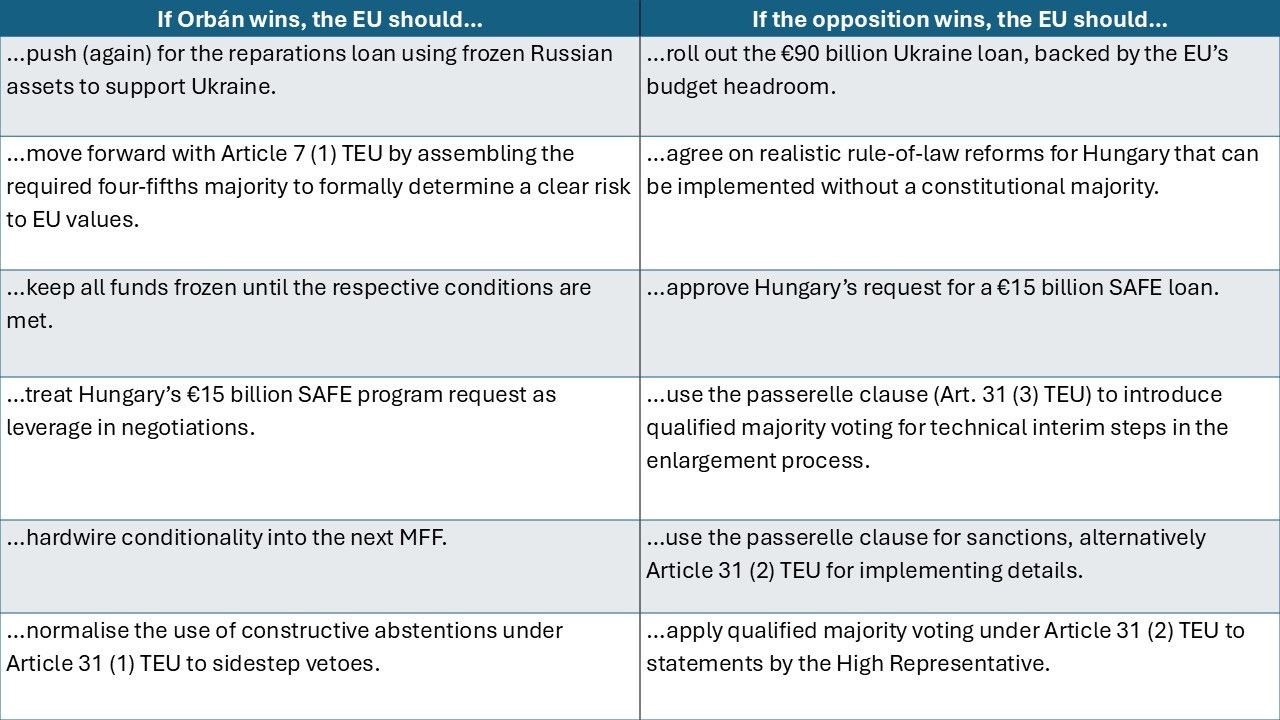
‘Nobody can blackmail the European Council, nobody can blackmail the European institutions. It’s completely unacceptable what Hungary is doing. And this behaviour cannot be accepted by the leaders,’ said Council President António Costa after the last EU summit in March. Recent reports of Hungary leaking confidential information to Russia have only added fuel to the fire. If Viktor Orbán remains in power, the EU should, at a minimum, agree on a reparations loan based on Russian assets to support Ukraine; encourage the use of constructive abstention; keep all funding streams suspended; use the SAFE programme as leverage; hardwire conditionality in the next MFF; and make progress under Article 7.
Scenario 2: The opposition wins
An opposition victory would not solve the EU’s problems overnight. A government led by Péter Magyar would likely command only a simple majority, not a constitutional majority. With a parliament reduced to three parties – Fidesz, Tisza and the far-right Homeland Movement – coalition options for Tisza would be quasi non-existent. What a Tisza government would inherit is best described as a ‘Frankenstate’. After 16 years of Orbán’s rule, Hungary is an illiberal state with institutions stacked with loyalists, a polarised society, and a dire economic and fiscal picture. Any new government would immediately face high expectations from its electorate and pressure for fiscal consolidation. A post-Orbán government would therefore have strong incentives to secure the rapid release of EU funds. At the same time, it would have only limited capacity to deliver sweeping rule-of-law reforms – a situation similar to that faced by Donald Tusk in Poland. Meanwhile, a defeated Orbán would likely switch to ‘hardcore opposition’: mobilisation against an inexperienced Tisza-government and a push for early elections.
For the EU, this amounts to a narrow window of opportunity. It should act quickly:
Rush to help Ukraine
No one should expect from a Tisza government a full U-turn on Ukraine. Zelensky remains unpopular in Hungary, scepticism regarding Ukraine is widespread, Péter Magyar has rejected ‘fast-track’ EU accession for Ukraine. What is more plausible is a ‘quiet’ alignment with the EU mainstream. Instead of engaging in staged conflicts with Brussels, Magyar will focus his political capital on domestic issues. The EU should therefore move quickly to roll out the €90 billion loan to Ukraine, backed by the EU’s budget headroom, as already agreed in principle by the European Council in December. Another veto by a new Hungarian government on this matter is unlikely.
Agree on a realistic reform package
In a first step, the Commission should move swiftly to approve Hungary’s €15 billion loan request under the SAFE programme, giving the new government some fiscal breathing space in a difficult domestic situation. At the same time, the Commission should prioritise a targeted package of reforms that can be delivered without a constitutional majority, e.g. strengthening public procurement oversight, anti-corruption enforcement, transparency rules, administrative appointments and cooperation with EU monitoring mechanisms. Once these reforms have been implemented, the Commission should release the funds under the conditionality mechanism in sequenced tranches.
However, the Commission should remain cautious for two reasons: Péter Magyar was a member of the governing party Fidesz until 2024, and his credentials as a credible reformer remain under scrutiny. Moreover, a February 2026 opinion by Advocate General Tamara Ćapeta – calling into question earlier Commission decisions on Hungary funding – highlights the legal and political risks. Even if non-binding, it underscores how precarious the Commission’s position is. To remain a credible defender of the rule of law, it should apply its milestones and enabling conditions rigorously.
Progress on Qualified Majority Voting
If the opposition wins, Hungary’s role as the EU’s notorious veto player could end. There would be a narrow window of opportunity for reforms. Yes, Hungary is not the only member state wary of a more capable EU. But none of the others – say Slovakia or the Czech Republic – has been as consistently obstructionist as Orbán’s Hungary. This creates an opening for pragmatic reform. The ‘Group of Friends on Improved Decision-Making’ – an informal coalition of 12 member states, including Germany, France and Slovenia – should take the lead. Its aim should not be a wholesale shift to qualified majority voting (QMV), but a targeted reform package in carefully selected areas where progress via so-called passerelle clauses is feasible. This clause (Article 31(3) TEU) allows the Council to move to QMV in defined areas. The group should advocate for three pragmatic yet consequential initiatives: (1) introduce QMV for technical steps in the EU’s enlargement process; (2) activate the passerelle for sanctions policy; (3) bring statements by the High Representative for Foreign Affairs under QMV.
(1) Shifting to QMV for technical steps in enlargement would make the process more predictable and efficient for both accession countries and the EU. At present, around 100 interim decisions are subject to veto. In future, steps such as opening negotiating clusters or approving benchmark assessment reports could be decided by QMV, while closing chapters and final accession decisions would remain subject to unanimity. Several member states, including Germany and Slovenia, have already proposed reforms along these lines.
(2) To activate the passerelle for sanctions policy, the Group of Friends should emphasise that vital national interests will remain protected. This could be ensured through a ‘sovereignty safety net’, inspired by Article 31(2) TEU, allowing member states to refer issues of vital national interest to the European Council – an approach put forward by the Franco-German Working Group on EU Institutional Reform. As a fallback, Article 31(2) TEU could at least be used to introduce QMV for implementing measures, such as updating sanctions listings.
(3) Statements made by the High Representative for Foreign Affairs and Security Policy on behalf of the EU do not formally require a vote, but in practice they rely on consensus. The Group of Friends should push for a substantive reform: Statements should be approved through a Council implementing decision by qualified majority, in line with Article 31(2) TEU. This would significantly strengthen the EU’s voice on the global stage.
If Péter Magyar and the Tisza party win Hungary’s parliamentary election, a historic window for pragmatic EU reform may open. But it will be brief. National elections in France, Poland, Italy and Slovakia are scheduled for 2027 and could produce new veto players. If the opposition wins the election, the EU ought to act quickly. It should rush to help Ukraine with the already agreed €90 billion loan; define a realistic rule-of-law reform package for Hungary; approve Hungary’s loan under the SAFE programme; and advocate for pragmatic use of the passerelle clause in areas such as enlargement, sanctions and statements by the High Representative. If these reforms succeed, they could shape the EU for years to come.
About the author
Florian Kommer is Senior Expert for “European Strategic Issues” at the Bertelsmann Stiftung.
Like what you're reading? The best way to keep up with our work is to subscribe to our newsletter.
Our Europe briefing with editorials by Lucas Guttenberg and Malte Zabel lands in your mailbox twice a month, with information on our events, publications and the latest updates from our experts.








Write a comment