Xi–Trump–Putin: What Their Summit Means for Europe
The meeting between Xi Jinping, Donald Trump and Vladimir Putin in Shenzhen produced a joint declaration and glossy pictures, but few concrete commitments. Yet for Europe, its significance goes beyond the immediate results – the rapprochement between the US and the world’s leading authoritarian powers heightens fears that European security is negotiable without Europe.
As host of this year’s Asia-Pacific Economic Cooperation (APEC) summit in Shenzhen, China sought to highlight its support for international cooperation, free trade and regional integration. But the meeting between Xi Jinping, Donald Trump and Vladimir Putin on 19 November overshadowed the wider APEC agenda. The trilateral meeting was reportedly proposed by Putin and endorsed by Trump. China appeared more cautious before confirming the meeting on November 16.
Ukraine’s president Volodymyr Zelensky and others had already raised concerns that the prospect of a meeting between the three leaders could be a possible “Yalta 2.0”– and for good reason. Putin and Trump have long seemed keen on dividing the world into spheres of influence, as Joseph Stalin and Franklin D. Roosevelt and Winston Churchill did with Europe in 1945. The idea is not alien to Xi Jinping either, who would very much like to see US influence in the Asia-Pacific region diminished.
The historical comparison, however, has its limits. While the Yalta Conference brought together wartime allies for several days to discuss Europe’s post-war future, the meeting in Shenzhen lasted just 90 minutes. The context is fundamentally different: In 1945, the foundations of Europe’s post-war order were still being negotiated. Today, an established European security order is being challenged by Russia’s war against Ukraine. However, the image of the three leaders sitting together could still be interpreted as a strong signal towards a new world order dominated by power and separated into spheres of influence – a world in which great powers decide the fate of other countries without them.
For Europe, this is the central concern. The challenge is not dialogue between Washington, Beijing and Moscow itself – keeping open channels of communication can help reduce tensions, prevent misunderstandings and manage the risk of escalation – but the possibility that issues affecting European security could be negotiated without sufficient European and Ukrainian participation.
Before the summit
Putin managed to hold an informal bilateral meeting with Trump prior to the grand finale. This was his first in-person meeting with Trump since their summit in Anchorage more than a year ago. But the backdrop was not entirely favourable for the Russian side and their comparison with the Yalta Conference. On the eve of the APEC summit, the Kerch Bridge partially collapsed after successful strikes by the Ukrainian Armed Forces, making it even more complicated to supply Crimea, including Yalta itself, with basic commodities, such as gasoline.
The American and the Russian sides both mentioned that Ukraine topped their talks. It is not clear yet what exactly was discussed. As neither Europe nor Ukraine were represented, the bilateral meeting highlighted the risk of European security and Ukraine’s fate being negotiated without them. Putin, however, walked out of the meeting having scored yet another diplomatic and PR win, proving that he is no longer a pariah on the international scene, but rather a “friend” of the sitting US President.
At the summit
The meeting started with a two-hour delay and lasted for about an hour and a half. In his opening remarks, Xi Jinping emphasised China’s wish for “a constructive relationship of strategic stability with the United States” – a framework proposed in May this year by China and endorsed by Donald Trump unquestioned.
Putin drew the WWII comparison again, trying to give the meeting the appearance of a G3 format. But for China, the relationship that truly matters is that with the United States. This became clear from the way the US president was courted by Xi Jinping during the two days in Shenzhen.
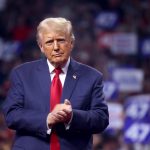
Trump criticised the International Criminal Court (ICC) at the beginning of the meeting and pointed to an area of “potential cooperation” against “rogue globalist organisations.” The proposal by the US president that the three permanent members of the UN Security Council should take joint action against the ICC was an unprecedented and flagrant attack on the international legal order and its fundamental universally stated values.
These statements reflected different priorities and demonstrate a willingness to pursue dialogue, but not necessarily a shared strategic agenda.
After the summit
There was no joint press conference. The three sides only published the China-Russia-US Leaders’ Declaration on Peace. The title seems almost cynical, given that two of the participants are currently waging a war. The declaration addresses four areas: UN reform, energy security, international criminal justice and nuclear risks.
First, the declaration called for reform of the United Nations to improve its ability to respond to global challenges and fulfil its peace and security mandate. While the statement did not specify which institutional reforms the governments would pursue, this reflects the intent, especially of China and Russia, to reshape the global order so it is more accommodating for their own principles and interests.
Second, the three leaders emphasised stable energy supplies and expressed their intention to increase the production and supply of refined petroleum products. While this is certainly in Trump’s interests, there are no binding targets nor an implementation mechanism, so practical consequences remain uncertain. Russia can use this as yet another tool to accuse Ukraine of attacking not only oil refineries, but to act against a declaration by the three nuclear powers.
Third, the text reflects Trump’s proposal on the ICC, but in a watered-down form. It merely states that the ICC and other similar institutions must respect the immunity of government officials and not abuse their jurisdiction. The fact that the three leading powers apparently see themselves above international law is concerning and yet another indication of their willingness to advance their interests at the expense of others.
Lastly, the three heads of state reaffirmed China’s narrative that a nuclear war can neither be won nor fought. They announced their intention to engage in a dialogue on reducing nuclear risks and preventing the proliferation of nuclear weapons. If there really was a meaningful dialogue between the three major nuclear powers and concrete actions, this would be a major step against proliferation. However, the likelihood for this to happen is minuscule.
Taken together, the four points demonstrate broad areas of stated interest, but provide little evidence of agreement on specific measures. In parallel to the summit, Germany, France and the UK co-hosted a meeting of the Coalition of the Willing, with roughly 40 participating delegations. Ukraine was the central topic. The timing was not a coincidence – the time difference between China and Europe allowed Europe to react to the outcomes of the trilateral summit in Shenzhen. German chancellor Friedrich Merz rebutted the Yalta comparison decisively by pointing out that the conference resulted in the Cold War and a divided Europe, which should never be allowed to happen again.
After the summit is before the summit
The summit should not obscure the substantial differences among the three governments. Major tensions remain between the US and China as their trade and technology rivalry continues; relations between Russia and China have become deeper, but remain a “marriage without love” imbued with a good portion of mutual mistrust. China regards the war against Ukraine as predominantly a matter of European security and wants no direct part in it, while the US president would like to end the war – and finally win the Nobel peace prize – and the Russian president has no intention to do so, at least on terms acceptable for Ukraine and Europe.
The trilateral meeting does not, by itself, establish a new world order. But it did hint to a potential future order where Europe is no sovereign player and cannot defend its interests. As the US sides with the world’s leading authoritarian powers, its allies in Europe face the question of how their interests may be represented in future diplomatic initiatives among the three – especially as they may continue their exchange at the G20 summit in Miami, on 14-15 December, with more time to prepare and more concrete outcomes.
The road to Miami: What Europe should do now
Europe should use the period before Miami to prepare rather than wait for the outcomes of further talks.
First, Ukraine and EU governments should agree on common priorities in regard to ending the war, international legal institutions and a robust European security order. With regards to ending the war, this means securing long-term financial support, agreeing on a clear political negotiating mandate, and developing credible and lasting security guarantees. Together, these priorities would strengthen Europe’s ability to act collectively and ensure that European and Ukrainian security interests are represented in future negotiations.
Second, European governments should coordinate closely with Ukraine and engage Washington early. This would help ensure that European and Ukrainian positions are communicated before any new proposals affecting their security are developed.
Third, European governments should insist on a credible and inclusive negotiating format. Russia’s invitation to European representatives to come to Moscow should not become a substitute for negotiations on equal terms. Any substantive talks about Ukraine’s future should include Ukraine from the outset and take place at a mutually agreed neutral venue. Europe should remain open to dialogue without allowing Moscow to determine the terms of European participation.
About the authors
Cora Jungbluth is Senior Expert for China and the Asia-Pacific at Bertelsmann Stiftung. She works on EU–China relations, foreign direct investment (FDI) and international trade, with a focus on de-risking and economic security.
Peter Walkenhorst is Senior Project Manager in Bertelsmann Stiftung’s Europe’s Future Program, where he works on transatlantic relations and European-Chinese relations. Previously, he was a member of the foundation’s Germany and Asia Program, responsible for projects on the systemic conflict with China and social cohesion in Asia.
Volodymyr Gushuley joined the Europe Program at the Bertelsmann Stiftung after working for nearly nine years at the EU Advisory Mission in Ukraine. His focus is on Eastern Europe and the ongoing EU enlargement process.
Like what you're reading? The best way to keep up with our work is to subscribe to our newsletter.
Our Europe briefing with editorials by Lucas Guttenberg and Malte Zabel lands in your mailbox twice a month, with information on our events, publications and the latest updates from our experts.






Write a comment