

Executive summary
Europe faces a convergence of crises: a crumbling international order, wars, democratic backsliding, economic stagnation, critical dependencies, and fracturing alliances. At the same time, the institutional architecture that underpinned its most prosperous decades is cracking.
The scenarios presented in this policy brief suggest that Europe’s future remains highly volatile. By 2035, Europe could drift towards fragmentation, lose strategic agency, or even face political disintegration. Equally, it could emerge as a more capable, cohesive, and influential actor. Which path Europe takes will depend on the political choices made in the second half of the 2020s.
Four scenarios illustrate these divergent potential trajectories:
- Europe Has Gone to Hell: The EU disintegrates amid economic decline, illiberal capture, and eroding security, leaving Europe dominated by external powers.
- Europe Forged in War: Europe restores its security credibility under existential threat, but at the cost of economic stagnation, democratic backsliding, and a narrowly focused policy agenda.
- Torn Apart and Ground Down: Europe becomes an arena of great-power competition, losing autonomy, cohesion, and competitiveness in an increasingly bipolar world.
- Europe’s Rise: Through rapid coordination on governance, investment, and security, the EU emerges as a capable global actor despite a hostile geopolitical environment.
With the EU at the eleventh hour, the scenarios point to four strategic priorities for policymakers before 2030:
• The EU and its Member States should be serious about growth, competitiveness, and resilience, by strengthening joint investment in European public goods, including collective defence, climate protection, and digital infrastructure, while deepening the Single Market.
• They should protect and strengthen Europe’s decision-making capacity through institutional safeguards that prevent paralysis in the face of growing political heterogeneity.
• Together with NATO allies, they should establish visible security credibility early, focusing on capabilities that stabilise expectations and deter adversarial probing.
• They should diversify global partnerships particularly with the UK, Norway, Canada, Australia, ASEAN, India, the Gulf states, Japan, South Korea, and the MERCOSUR countries.
Early, visible, and coordinated action could keep Europe on a path towards greater strategic agency and ultimately preserve its ability to shape its own future and sustain the European model. The alternative is not a wobbly but enduring status quo, but a gradual drift towards the negative outcomes detailed in scenarios one through three.
Introduction
The international order that long provided Europe with stability and prosperity has weakened substantially. War has been deliberately brought back to the EU’s neighbourhood, democratic norms are being actively undermined, and economic growth is faltering amid critical external dependencies. Each crisis reinforces the others, creating a level of uncertainty that conventional policy approaches are ill-equipped to navigate.
In such an environment, linear projections and incremental planning fall short. What is required instead is a deliberate effort to broaden the range of what we consider possible – to map alternative trajectories, challenge entrenched assumptions, and identify where strategic choices will matter most.
Scenario construction and analysis offer precisely this. It helps define critical uncertainties, explore how political, economic, and geopolitical dynamics might interact, and illuminate where and when strategic choices matter most for policymakers in the coming decade.
The four scenarios presented in this report offer distinct perspectives on what the European – and, to some extent, global – order might look like in 2035. They are the product of an intensive process conducted by the Bertelsmann Stiftung’s Europe team, in collaboration with colleagues from other programmes and with guidance from Foresight Intelligence. Across three multi-day workshops, experts identified, analysed, and projected the decisive drivers and trends shaping Europe’s future, developing a set of plausible scenarios.
These scenarios do not simply describe possible end states ten years from now. They also trace coherent, credible – though ultimately fictional – pathways leading to those futures. The precise sequence of events matters less than the underlying logic. The aim is to make Europe’s possible futures – and the pathways leading towards them – more tangible, more concrete, and therefore more actionable. After all, negative futures are easier to prevent – and positive outcomes more likely to be achieved – when the pathways leading to them are understood.
Scenario 1: Europe Has Gone to Hell
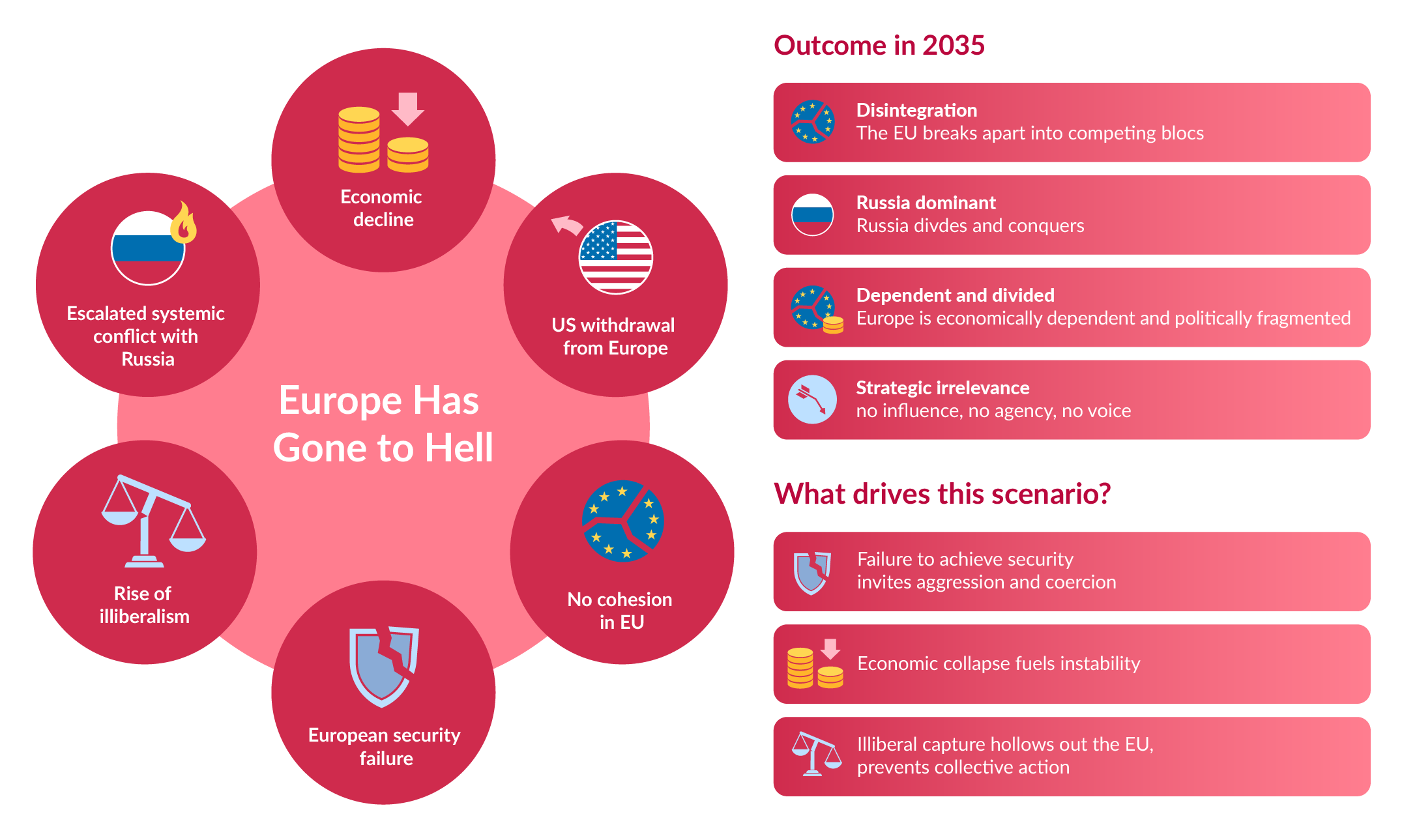
The situation in 2035
A sustained loss of coordination among EU Member States, combined with a collapse in European security credibility, triggers a systemic breakdown across the continent. By 2035, Russia has emerged as the dominant power in Europe. Guided by a strategy of divide and rule, Moscow repeatedly exploits political fractures and fuels conflicts and separatist movements across Europe’s neighbourhood. The Baltic states are under Russian occupation. The EU has effectively disintegrated and is politically irrelevant. Europe’s collective security architecture has unravelled, leaving societies increasingly vulnerable to hybrid attacks and political destabilisation. The euro and its supporting institutions have been dismantled. The Single Market has fragmented into competing regional economic blocs, regularly triggering trade conflicts.
Europe has become increasingly dependent on technology, energy, and raw materials from the United States and Russia. Across much of the continent, illiberal governments have consolidated power, weakening or openly suppressing independent media, judicial oversight, and civil society institutions. European values continue to erode, while women, minorities, and marginalised groups face growing discrimination. The United States has withdrawn from Europe, shifting its strategic focus towards the Indo-Pacific and long-term confrontation with China. The international order has evolved into a concert of great powers dominated by the United States and, once again including, Russia.
How we get there
The erosion of transatlantic relations accelerates in the late 2020s. Following the 2026 midterm elections and the 2028 presidential election, the political influence of the MAGA movement continues to shape the direction of the United States. Under a Tough on China agenda, Washington steadily reallocates military assets and strategic attention to the Indo-Pacific, leaving an increasingly visible security gap in Europe. At the same time, illiberal parties gain momentum across the continent, winning elections in several EU Member States between 2026 and 2027.
In early 2028, Russia breaks through Ukrainian defensive lines, forcing Ukraine into a dictated peace settlement and installing a compliant government in Kyiv. Ukraine is subsequently integrated into the Eurasian Economic Union, with similar offers extended to other European countries. Russia’s victory frees it from its status as junior partner to China. Following the MAGA election victory that year – amid growing doubts about the fairness of the electoral process – the American president signals that the US will not oppose further Russian expansion in Eastern Europe.
In 2029, Russia invades the Baltic states. Despite NATO and EU defence commitments, no meaningful collective response materialises. The US limits itself to financial support, while European states provide equipment, but no significant troop deployments. Within months, the Baltic states surrender, accelerating the EU’s fragmentation, undermining public trust in EU institutions, and strengthening nationalist forces.
Investment in Europe collapses, the euro comes under pressure, and by 2032 the European banking system fails. Economic decline, insecurity, and illiberalism reinforce one another, driving deep political polarisation.
By 2035, most European countries are governed by illiberal forces. The EU has effectively collapsed, and Russia dominates the continent, while Europe becomes increasingly dependent externally and increasingly divided internally.
Scenario 2: Europe Forged in War
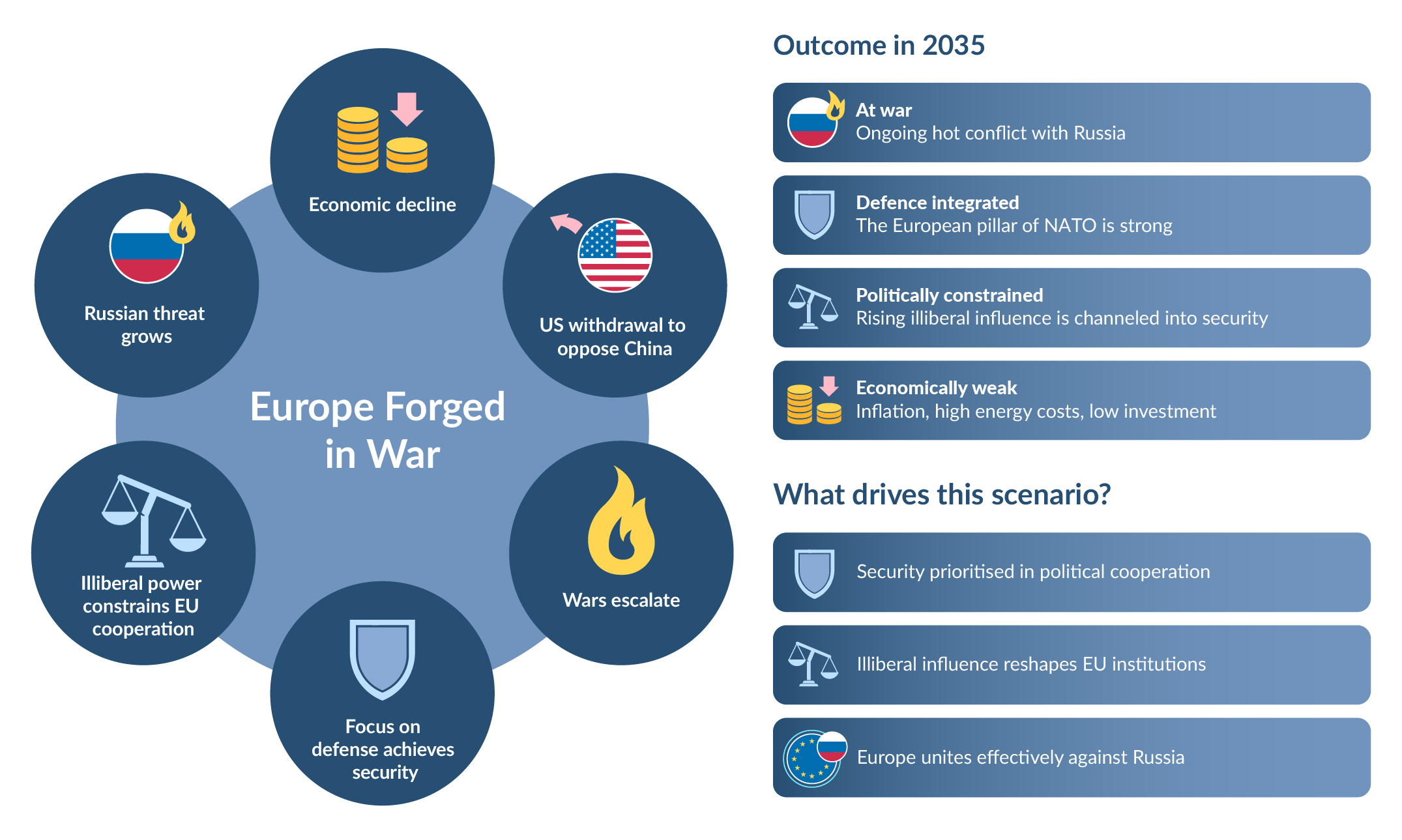
The situation in 2035
Existential external threats have brought Europe closer together, but political fragmentation has fundamentally altered the nature and scope of European cooperation. Following Russia’s invasion of Estonia, Finland, and Norway, European NATO members are engaged in an ongoing war with Russia. European forces have stabilised the front, but heavy fighting continues. Across the rest of Europe, an intense hybrid conflict is underway, involving sabotage, cyberattacks, and political destabilisation. The EU remains politically heterogeneous, but illiberal forces across the continent have turned away from Russia.
A shared perception of external threats ensures that cooperation in security and defence functions effectively. The European defence industry and procurement structures have been consolidated, and through a smart division of labour, targeted investment, and accelerated innovation, the EU has reduced its dependence on US weapons systems while strengthening its own digital and technological capabilities. The United Kingdom and France have extended their nuclear umbrella to the rest of the EU and European NATO members. Other policy areas have been subordinated to security priorities or – as in the case of cohesion and climate policy – largely abandoned. Democratic governance and rule-of-law institutions have also been deprioritised.
The European economy is heavily burdened by the war. Energy prices and inflation remain high, while employment is close to full capacity. Industrial policy is geared towards dual-use goods and services. High-value consumer goods and foreign direct investment increasingly come from China, now the world’s leading economic and technological power.
How we get there
In 2026, the war in Ukraine ends in a dictated peace. Pro-Russian forces take power in Kyiv, and the occupied territories are formally integrated into the Russian Federation. The outcome prompts EU Member States to intensify efforts to build independent defence capabilities, primarily by strengthening the European pillar of NATO.
In Europe’s 2027 super election year, illiberal parties secure majorities in France, Italy, and Poland, followed shortly thereafter by Croatia. This increasingly fragmented political landscape complicates further European integration. Internationally, illiberalism also continues to advance, with a MAGA Republican winning the 2028 US presidential election and extending the domestic and foreign policy disruptions of previous years. Germany remains under centrist leadership following the 2029 federal election, emerging as a key liberal counterweight, while elections to the European Parliament confirm the continent’s deep political divisions.
To preserve Europe’s capacity for action, EU leaders pursue a pragmatic European Grand Bargain, prioritising defence and strategic resilience over other policy objectives. Budgets for rule-of-law institutions, social investment, and environmental policy are sharply reduced, reflecting a broader shift towards security-driven cooperation.
By the early 2030s, cooperation in defence, energy, and industrial policy improves significantly, supported by large-scale joint investment projects and a strengthened European defence-industrial base. At the same time, China uses its greatly expanded diplomatic and economic influence in Europe to preserve strategic dependencies on China.
In 2032, following an earlier withdrawal of US troops from Europe, escalating hybrid attacks culminate in a Russian invasion of Finland, Estonia, and demilitarised Svalbard. Although Europe mobilises rapidly, it faces the crisis largely alone. The existential threat erodes the remaining political resistance to deeper defence cooperation.
By 2034, European forces have stabilised the front and begin to push Russian forces back, but the conflict remains unresolved. Negotiations are underway, yet their outcome remains uncertain, leaving Europe in a prolonged state of military mobilisation and political tension.
Scenario 3: Torn Apart and Ground Down
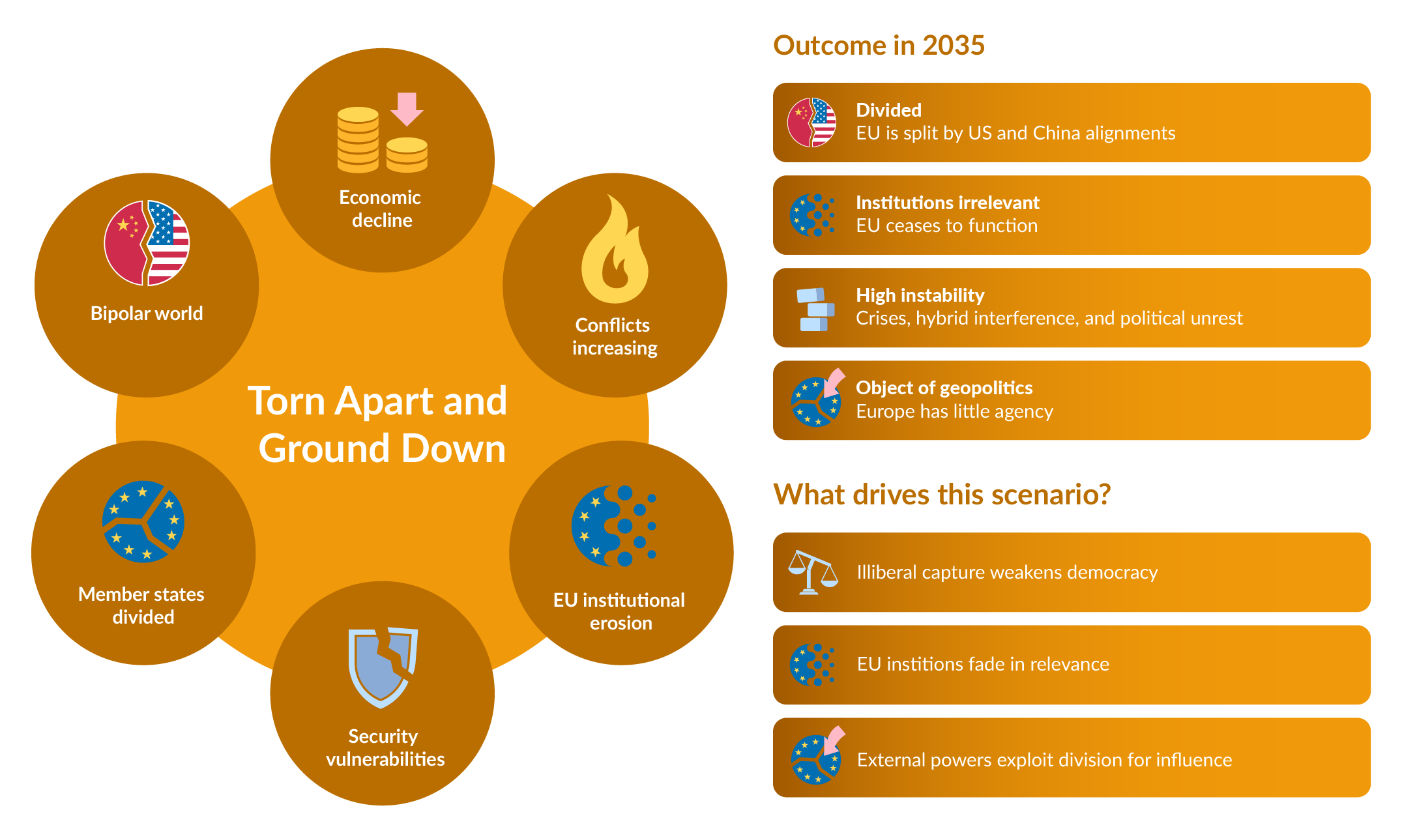
The situation in 2035
External great-power dynamics exert constant pressure on a fragmented Europe. The continent has become the battleground of a geopolitical conflict between an illiberal United States and China, as both powers compete for strategic dominance across Europe. They cultivate asymmetric relationships, foment political unrest, finance coups and subversive activities, and, in some cases, directly impose changes of government. The level of conflict across Europe is high. With few exceptions, EU Member States are governed by illiberal forces and dependent on either the United States or China.
The EU’s institutional structure has been steadily undermined, and cooperation persists only where it does not conflict with American or Chinese hegemonic interests. Without a common trade policy or a functioning Single Market, Europe is no longer economically competitive with either the United States or China. The EU is also unable to guarantee its own security. Russia has occupied Svalbard – a demilitarised Arctic territory of growing strategic importance – but has refrained from further escalation at China’s insistence. Elsewhere, European states seek protection under the security umbrella of one of the major powers. Europe lacks the resources and capabilities to resist these developments. Caught between the United States and China, it is being crushed and torn apart, increasingly stripped of its autonomy. The international order – and Europe’s security within it – remains highly unstable.
How we get there
In 2026, the global economic situation deteriorates sharply. Aggressive US tariff and foreign policies and military escalation abroad – including war with Iran – trigger a global recession, disrupting supply chains and undermining confidence in financial markets. The international banking system begins to wobble, global exports decline, and the EU enters a severe economic downturn throughout late 2026 and 2027.
At the same time, the war in Ukraine continues. Ceasefires repeatedly collapse, and European support for Ukraine persists, while Russia’s dependence on China deepens, reinforcing their increasingly asymmetric partnership. Within the EU, economic hardship fuels political polarisation and strengthens illiberal forces. Their campaigns – often amplified by Russian hybrid interference – gain growing traction. Between 2027 and 2029, illiberal parties win most national elections. France shifts course first, ending support for Ukraine. The move weakens both European and American backing, ultimately forcing Kyiv into a dictated peace.
By 2029, both sides of the Atlantic are dominated by illiberal governments. In Europe, this accelerates the erosion of common institutions. France and Germany pursue increasingly divergent external alignments: Germany deepens bilateral cooperation with the United States, while France turns towards closer engagement with China. Both Berlin and Paris increasingly bypass the EU framework, tighten border controls, and disengage from core EU legal structures, undermining the Union’s coherence and credibility.
Russia exploits this fragmentation. In 2030, it tests Europe’s defence credibility by occupying Svalbard, facing little resistance. At the same time, China asserts itself globally by blockading Taiwan, further consolidating an emerging bipolar world order. Europe becomes increasingly divided, with states aligning either with the United States or China under unequal conditions.
By the early 2030s, Europe has become the primary arena of great-power competition. External actors exert influence through economic leverage, political pressure, cyber operations, and covert interference, deepening internal divisions. As instability spreads and cooperation collapses, EU institutions gradually cease to function. By 2034, the Union is effectively dissolving – not through a single dramatic rupture, but through a slow and cumulative slide into political irrelevance.
Scenario 4: Europe’s Rise
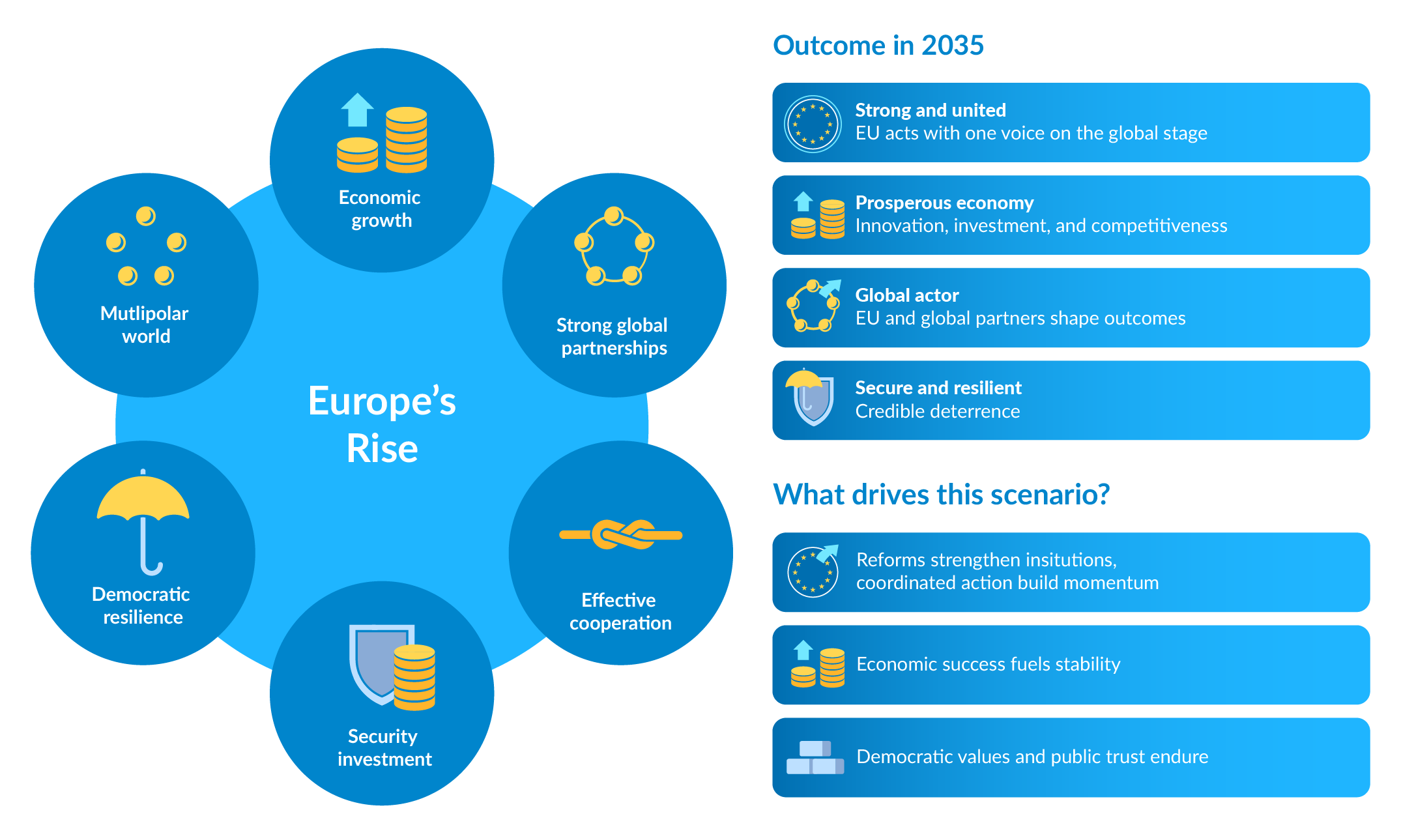
The situation in 2035
The EU is economically and militarily strong, with the extension of qualified majority voting having accelerated decision-making and strengthened the Union’s capacity to act – particularly in foreign policy and enlargement. Non-EU European and neighbouring states are more deeply integrated, while a larger and more effective EU budget finances shared investment in European public goods, including collective defence, climate protection, and digital infrastructure. A ceasefire in Ukraine is secured by a European coalition of the willing. Europe is well equipped to counter hybrid threats, and digitalisation, combined with smart regulation, has helped promote European platforms and open-source solutions. The economy is dynamic, generating competitive innovations in key technologies.
The EU is able to guarantee its own security through adjusted defence budgets, strengthened military cooperation, and credible conventional capabilities. New forms of cross-border strategic planning, procurement, and troop training have proven effective. The EU and its Member States have also strengthened both their input and output legitimacy, while European democracies have become more effective at containing and countering illiberal forces. Internationally, the EU has emerged as an independent centre of power, able to cooperate and compete with the United States and China on broadly equal terms in many areas. Overall, the EU acts as a pragmatic and effective counterweight to authoritarian powers and serves as a point of reference for liberal forces worldwide.
How we get there
In 2026, Russia not only continues its war against Ukraine, but also escalates its hybrid campaign against key EU Member States – particularly through heavy cyberattacks. At the same time, the further erosion of transatlantic relations under Trump 2.0, combined with the growing scale of Russian aggression, prompts a serious European response. A coalition of willing states – led by Germany, France, the United Kingdom, Poland, the Netherlands, and several Central and Eastern European countries – commits to securing a ceasefire in Ukraine by the end of the year. At the same time, these states agree to accelerate the build-up of European defence capabilities over the following five years, with the aim of deterring Russia effectively even without relying on US military support. Following Democratic gains in the US midterm elections, Washington continues to provide interim support, helping to close immediate capability gaps.
Economic growth returns in late 2027, driven by a ceasefire in Iran, increased public investment – particularly in Germany – and improved competitiveness following regulatory reforms, including smart simplification and the completion of the savings and investment union. Building on Franco-German alignment, the EU agrees on a concrete roadmap for the gradual alignment of standards in strategic sectors, including electric vehicles and other green technologies. Transparency and cooperation expand across additional strategic domains, including critical raw materials, helping to diversify supply chains and reduce external dependencies. Meanwhile, deeper engagement with non-European partners – particularly Canada, India, the Gulf states, Japan, ASEAN, Australia, and the MERCOSUR countries – becomes a key driver of economic diversification and strategic resilience.
In early 2027, the Days of Europe – a decisive meeting of the European Council – effectively ends unanimity in key areas of EU decision-making through the extensive use of the passerelle clause, including in technical aspects of the enlargement process. New coalitions of the willing emerge in strategic areas such as technological sovereignty. Security cooperation with the UK and Norway deepens further, strengthening the European pillar of NATO.
These developments reinforce one another. Economic growth and visible policy successes strengthen political stability, pushing illiberal forces to the margins. Pro-European governments secure electoral victories during Europe’s super election year in 2027, and the political centre regains ground across both Europe and the United States.
By the early 2030s, Europe’s technological and economic position has strengthened significantly. Advances in digital infrastructure, artificial intelligence, and green technologies underpin competitiveness, while European firms emerge as global leaders in several strategic sectors.
European Member States continue to advance their efforts towards strategic autonomy. In 2031, the newly developed EuroDome missile defence system reaches initial operational capability. By 2035, European defence systems reach full operational readiness. Combined with sustained economic growth and political cohesion, this enables the EU to act as a unified global actor, advancing enlargement and speaking with one voice in international institutions.
Failure is self-reinforcing, success must be built
Despite the bleak outlook of most of these scenarios, the implication is not that Europe faces likely – let alone inevitable – decline, but rather that strategic agency must be actively cultivated and sustained. The scenarios suggest that Europe’s future will be shaped partly by the intensity of external pressure, but more importantly by how internal political, economic, and security dynamics interact over time.
Across the adverse scenarios, a familiar pattern emerges. Economic stagnation or crisis fuels political polarisation and strengthens illiberal actors, who blame the EU and offer seemingly simple, national solutions. As these forces gain influence, Member State governments find it increasingly difficult to cooperate at the European level. Certain governments slow or block collective decision-making, particularly in areas that depend on trust, solidarity, and long-term commitment – such as security, fiscal policy, or crisis response. This paralysis, in turn, increases Europe’s vulnerability to external pressure, further undermining confidence, investment, and political cohesion. The cycle then repeats itself at a higher level of instability.
Once this dynamic takes hold, time works against recovery. The scenarios suggest that reversing such downward spirals over the course of a decade would require far greater political capital and economic resources than would have been needed to prevent them in the first place. Conversely, in the more favourable trajectories, progress in economic performance, security, and political cohesion becomes self-reinforcing, making further cooperation easier, more credible, and more effective over time. For policymakers, the implication is clear: delaying coordination raises costs and steadily narrows the range of viable options.
Accordingly, the scenario in which Europe remains a capable and autonomous actor can only emerge through deliberate and sustained action. It is not the product of a sudden – and currently unlikely – return to stable transatlantic relations on the back of MAGA’s possible downfall in the next presidential election. Nor does it depend on perfect political alignment among Member States across major policy areas. Instead, it is characterised by visible and mutually reinforcing action that spans governance reform, economic investment, and security cooperation.
The conclusion is therefore not that Europe must choose between ideal outcomes or collapse. Rather, the scenarios underline a simpler reality: success must be built deliberately, while failure tends to emerge by default when coordination breaks down.
Fields of action: What to set in motion now
The scenarios convey an urgent lesson for policymakers: Europe’s future will not be determined by any single factor. Yet policymakers can reduce the risk of negative feedback loops by deliberately building the conditions for greater strategic capacity and political agency. The late 2020s therefore represent a critical window for action. By 2035, several of the trajectories outlined in these scenarios become markedly harder to reverse.
It is time for policymakers to pursue bold and decisive action on core strategic priorities, making use of powerful policy levers at both the EU and national levels that have so far remained underutilised.
1. Make growth a true strategic focus, with competitiveness policies serving as a means to an end rather than a patch for vulnerabilities. To this end, the EU and its Member States should reassess and recalibrate their economic policy agenda. Priorities such as simplification alone will not be sufficient to deliver sustained growth, competitiveness, and resilience. Before 2030, the EU should deepen Single Market integration – particularly in capital markets – and strengthen the framework conditions for innovative firms, including through targeted public investment. European capitals should not underestimate the disruptive potential of a second China Shock to Europe’s established industrial strengths and should respond accordingly through existing – and, where necessary, new – EU trade defence instruments. At the same time, Europe should invest at scale in sectors that underpin long-term resilience, including through joint financing of European public goods such as collective defence, climate protection, and digital infrastructure. Faster capital deployment into dual-use infrastructure and clean technologies will be equally essential, alongside measures to reduce critical dependencies without fragmenting the Single Market.
2. Safeguard and strengthen Europe’s decision-making capacity and prevent political stalemate. The scenarios show that illiberal capture need not dismantle the EU to weaken it. It can also hollow out the Union’s ability to act from within. More broadly, the risk is not limited to illiberal veto players, but includes growing paralysis in an increasingly heterogeneous Union. Before 2030, Brussels and the Member States should therefore pursue institutional reforms that preserve collective action and reduce the risk of political deadlock. The European Commission and Member States should implement clear conditionality for EU funding, enforceable rule-of-law safeguards, and governance arrangements that prevent any single actor – or small group of actors – from blocking critical decisions in security and economic policy. Strengthening decision-making capacity in this way will also be essential in preparing the EU for enlargement, which could significantly enhance Europe’s economic weight and security position over the coming decade.
3. Treat credible European security as the foundation of economic and political stability and act decisively to secure it. Without credible deterrence, Europe’s capacity to act erodes quickly across these scenarios. By 2030, Europe should accelerate capability development and military readiness in areas where credibility can be built most rapidly. These include air and missile defence, cyber resilience, and the protection of critical infrastructure. France, the United Kingdom, and EU Member States should also explore options for extending nuclear deterrence to protect all EU members. Even gradual progress – if backed by sustained political resolve and credible implementation – can strengthen deterrence, stabilise expectations, and reduce the risk of external coercion or military escalation.
4. Broaden Europe’s options for partners in an unstable global order. The future configuration of global power remains uncertain. Whether the world moves towards unipolarity, bipolarity, or a more fragmented multipolar order, Europe will benefit from diversified partnerships and fewer single-point dependencies. Before 2030, the EU and its Member States should deepen strategic ties with key middle powers, using trade, investment, standard-setting, and security cooperation as complementary instruments. Beyond its immediate neighbourhood – particularly the United Kingdom and Norway – Europe should deepen engagement with Canada, India, the Gulf states, Japan, South Korea, ASEAN, Australia, and the MERCOSUR countries.
The consequence of inaction in competitiveness, decision-making capacity, deterrence, and strengthening global ties will not be a neutral status quo, but a gradual slide towards the negative scenarios outlined above. Outcomes ranging from a hollowed-out EU serving national power consolidation, to a Europe exposed to external economic coercion without credible defences, to a continent pulled apart by rival great powers – or, in the worst case, war and disintegration – all remain plausible.
This scenario exercise makes one point clear: the choice is not between perfection and collapse, but between acting now to strengthen Europe’s capacity in areas already within reach, or being forced into reactive crisis management later under far worse conditions.
Methodology
In a series of three two-day workshops in 2025, the Bertelsmann Stiftung’s Europe team, together with colleagues from other programmes, carried out the European Order 2035 scenario process with guidance by Foresight Intelligence, an organisational consultancy that supports strategic foresight processes. The exercise was designed to identify the key factors likely to shape Europe’s economic, political, and security trajectory from 2025 to 2035, analyse possible developments, and develop a set of plausible future scenarios.
The selected key factors were:
- the degree of cooperation and capacity to act in Europe;
- the level of systemic conflict between Russia and Europe;
- who primarily drives the effects of digitalisation;
- Europe’s relative economic performance;
- Europe’s ability to guarantee its own security;
- the undermining of national democracies by illiberal parties and the illiberal capture of the EU;
- the configuration of power in the international system; and
- the intensity of conflict in Europe.
These eight key factors were projected into the future alongside four important background trends that do not appear explicitly in the scenarios themselves: pressure on livelihoods resulting from climate change, Europe’s critical import dependencies, diverging living standards, and demographic change.
The aim was to develop plausible assumptions about how each of these key factors might evolve and, in turn, how changes in one factor might influence others in shaping the European Order by 2035.
An interaction analysis was then conducted to assess how different projections of each key factor would affect all other key factors. Based on the resulting interaction matrix, specialised software was used to generate several internally consistent combinations of projections – the so-called raw scenarios.
From these, a subset of raw scenarios was selected for further development, with the aim of covering a broad spectrum of plausible alternative futures while maintaining analytical relevance. These were then elaborated into fully developed scenarios by constructing concrete future situations for the year 2035.
Building on these end states, backcasting techniques were applied to trace plausible, non-linear pathways back to the present, grounded in the identified interaction logics. The scenarios were then further refined through narrative development before being reviewed and validated.
About the authors
Malte Zabel is Director of the Bertelsmann Stiftung’s Europe’s Future Programmme.
Nathan Crist is Project Manager in the Bertelsmann Stiftung’s Europe’s Future Programmme.

Kommentar schreiben