

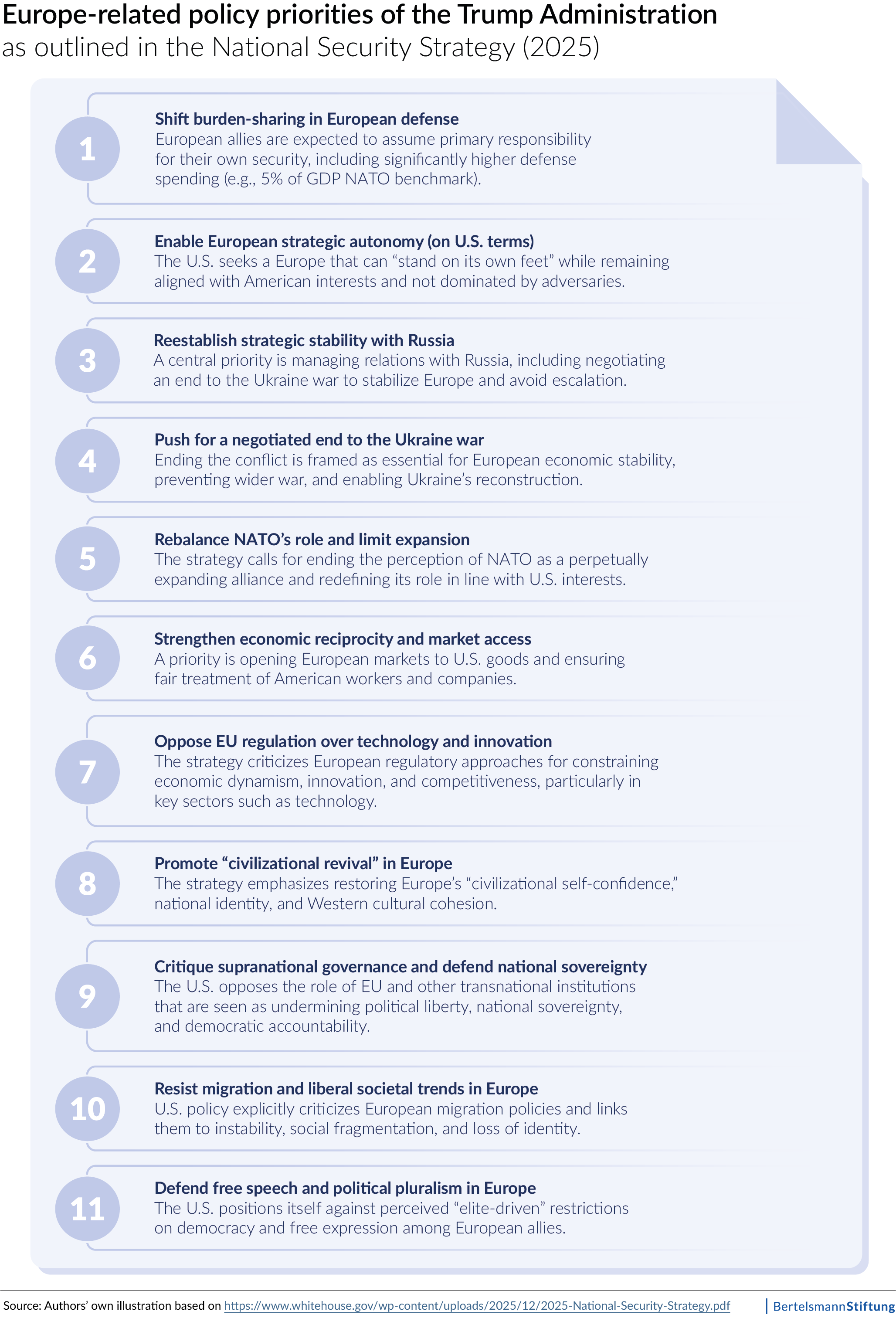
The release of the U.S. National Security Strategy (NSS) and National Defense Strategy (NDS) at the turn of 2026 marked a critical inflection point in transatlantic relations. Together, they provided the first official codification of the second Trump administration’s strategic priorities toward Europe. The NSS goes beyond familiar U.S. demands for increased defense spending and burden sharing, adopting, in places, an openly adversarial tone toward the EU and Europe’s political direction. Its treatment of sovereignty, regulation, migration, and democracy casts the EU less as a partner than as a political and economic model the U.S. seeks to reshape. The NDS reinforces this shift by signaling a more selective U.S. defense posture and greater pressure on Europe to assume more responsibility for its own security and defense.
Six months later, however, U.S. policy remains unpredictable, contradictory, and fragmented despite these strategy documents. Administration priorities, budgetary realities, congressional constraints, and ad hoc presidential decision-making often pull in different directions. Europe’s challenge is not simply a more assertive U.S., but a structurally more volatile and fragmented U.S. policymaking environment that creates uncertainty simultaneously across security, economic, and political domains.
Europe’s collective response should focus on three priorities:
- Define collective European red lines and credible response mechanisms.
- Strengthen Europe’s strategic resilience while preserving transatlantic cooperation wherever interests still align.
- Broaden European engagement across the U.S. policy landscape.
For full recommendations, please see below.
NSS and NDS as signals of U.S. political priorities
The release of the NSS and NDS followed nearly a year of signals that the White House’s approach to Europe was fundamentally changing. U.S. Vice President JD Vance’s February 2025 Munich Security Conference speech was an early indicator: U.S. criticism of Europe was no longer confined to defense spending, trade, or China policy, but increasingly extended to Europe’s political direction, regulatory model, and the legitimacy of the European Union itself.
The NSS directly targets the EU, warning that “the larger issues facing Europe include activities of the European Union and other transnational bodies that undermine political liberty and sovereignty.” The broader pattern of implementation record points in the same direction: a weaker and more divided Europe is viewed as easier to engage with on a bilateral basis and thus more susceptible to U.S. leverage.
For European governments, the NSS and NDS serve as useful indicators of the administration’s political priorities. They also matter because the normal machinery of U.S. policy coordination has weakened. The hollowing out of the National Security Council and the reduction of interagency coordination have made U.S. decision-making more fragmented. In this context, the NSS and NDS function less as operational plans than as alternative forms of guidance where regular policymaking channels have faltered.
Why the NSS and NDS are not policy blueprints
The NSS and NDS should not be mistaken for a complete guide to U.S. foreign and security policy toward Europe. They reveal the administration’s worldview, but actual policy over the last six months has been shaped by presidential improvisation, competing congressional priorities, and, more recently, by crises outside Europe.
The Iran conflict illustrates the gap between strategy and policy reality. The NSS describes the Middle East as a region historically “rife with conflict,” but argues that this dynamic “no longer holds,” while the NDS frames U.S. objectives around a “more peaceful and prosperous Middle East.” Developments in the region show how quickly presidential decision-making can move beyond, or contradict, the assumptions and priorities embedded in formal strategy documents.
The same logic applies to Europe. U.S. policy has been shaped not only by the NSS and NDS, but also by U.S. President Donald Trump’s unpredictable approach to Russian President Vladimir Putin, pressure for a quick settlement to Russia’s full-scale invasion of Ukraine, recurring threats to leave NATO, tariff and regulatory disputes, and repeated threats to forcibly annex Greenland from fellow NATO member Denmark.
Cooperation and dialogue continue between the United States and its transatlantic partners on U.S. weapons procurement for Ukraine, China-related risks, critical minerals, and supply chains. However, Europe must now navigate a U.S. approach that is more transactional, less predictable, and increasingly hostile toward the EU, making collective European adaptation and engagement more challenging.
I. Security order and strategic stability
The NSS and NDS present a sharper and more conditional U.S. approach to European security. Successive U.S. administrations from both political parties have long pressed European allies to increase defense spending. What distinguishes the second Trump administration is the extent to which this demand is now linked to alignment with, and responsiveness to, U.S. policy priorities.
The NDS argues that European allies should “take the lead” in addressing threats to European security, with the United States providing “critical but more limited support.” It also presents NATO allies as capable of assuming this role, pointing to Europe’s economic weight relative to Russia and its growing responsibility for its own conventional defense. Ukraine is central to this shift: the NSS and NDS frame ending the war as necessary for European stability while shifting primary responsibility for Ukraine’s defense, and for maintaining any eventual peace settlement, onto Europe.
Increased European defense spending and U.S. troop reductions
Burden sharing has been one of the administration’s clearest priorities – and one of its most successful. Throughout the first half of 2025, U.S. diplomatic and defense engagement with NATO allies focused on securing agreement at the Hague Summit on a new 5 percent defense-spending target: 3.5 percent of GDP for core military spending and 1.5 percent for broader security-related expenditures.
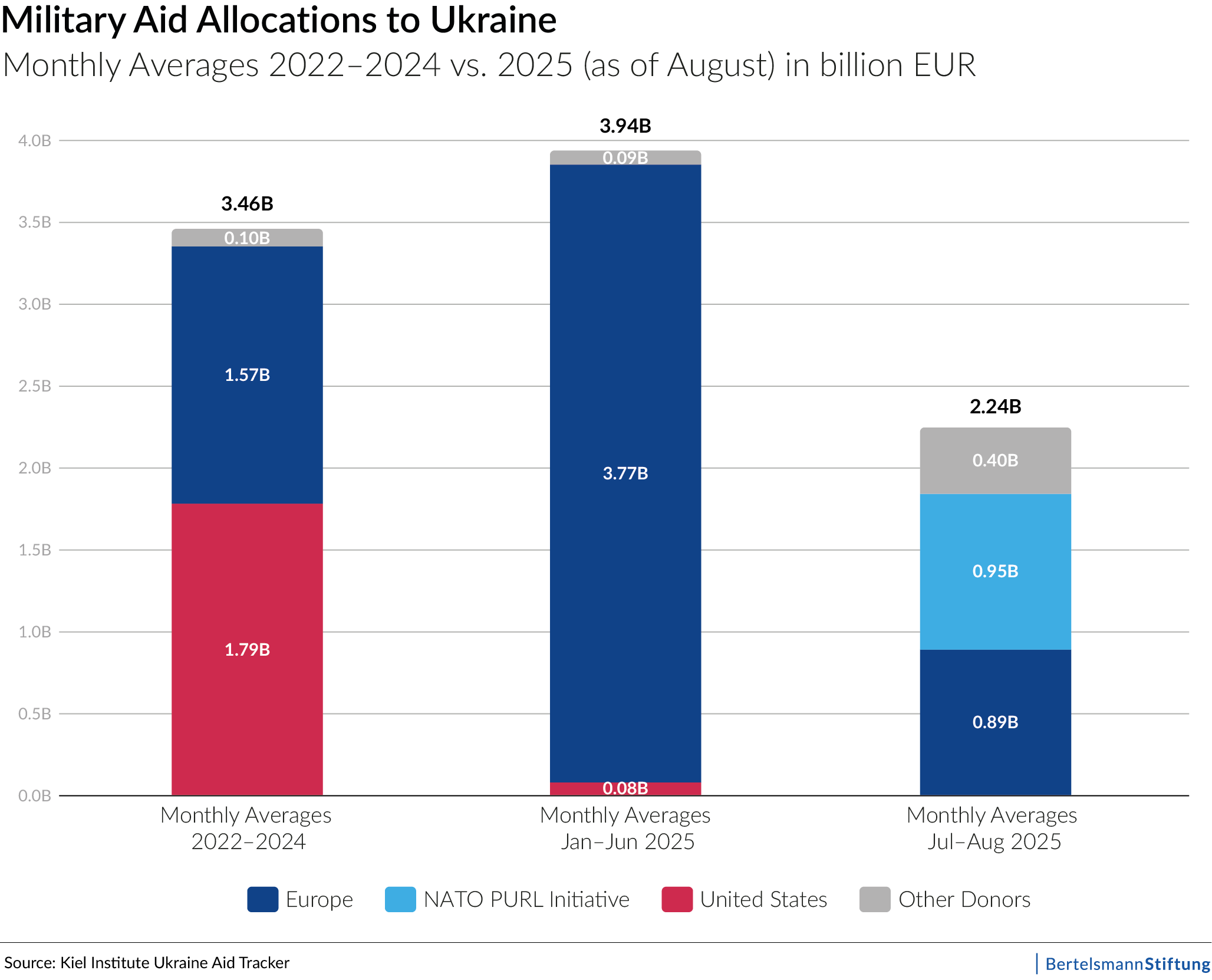
Burden sharing has also shaped U.S. policy toward Ukraine. Through the Prioritised Ukraine Requirements List (PURL), European allies and Canada finance packages of U.S.-supplied defense equipment for Ukraine, while NATO helps to validate Ukraine’s priority needs and coordinates delivery. This preserves transatlantic cooperation, but on terms that shift a greater share of the cost of military assistance onto non-U.S. allies. According to the Kiel Institute for the World Economy’s Ukraine Support Tracker, U.S. aid to Ukraine fell by 99 percent in 2025, while European military aid increased by 67 percent and financial and humanitarian assistance by 59 percent compared with the 2022-24 average.
At the same time, the U.S. military presence in Europe has continued to decline. By April 2025, U.S. European Command reported nearly 80,000 U.S. service members stationed in Europe, down from roughly 105,000 following Russia’s invasion of Ukraine.
Subsequent U.S. force-posture decisions have been erratic. Washington ended the replacement of a Romania-based rotational force, reducing the U.S. presence on NATO’s southeastern flank. Separately, it announced the withdrawal of 5,000 U.S. troops from Germany following a public dispute between President Trump and German Chancellor Friedrich Merz over the Iran war, making the decision appear less like a planned posture adjustment than a political signal directed to Berlin. The administration’s reversal of the Biden-era plan to begin episodic deployments of SM-6, Tomahawk, and developmental hypersonic weapons to Germany from 2026 reinforced the perception that key elements of the U.S. military posture in Europe could be withdrawn, delayed, or withheld for political reasons.
Poland points to the same volatility from the opposite direction. The administration initially cancelled a planned deployment of 4,000 troops, despite Poland’s status as one of NATO’s highest-spending allies: in 2025, Warsaw spent 4.48 percent of GDP on defense, more than any other NATO member, including the United States. A week later, Washington reversed course and announced the deployment of 5,000 troops, with Trump citing his close relationship with Polish President Karol Nawrocki, who is aligned with the right-wing Law and Justice (PiS) party, rather than Poland’s defense-spending record. The reversal highlighted that high levels of defense spending do not necessarily guarantee predictability in U.S. policy.
Furthermore, White House rhetoric implying a more conditional approach to NATO’s Article 5 commitments has raised doubts about whether Washington would uphold its obligations if tested, while Trump’s threats to annex Greenland from Denmark – through tariff pressure and even the possible use of military force – have eroded trust in the U.S. pillar of the alliance.
Implications for Europe: Strengthening Europe’s defense amid U.S. uncertainty
The central implication for Europe is that U.S. commitments to NATO and force-posture adjustments are not being implemented in a clear, structured, or predictable manner. European governments have been awaiting a Pentagon force-posture review that has yet to provide a stable framework for understanding which U.S. capabilities will remain, which will be reduced, and under what conditions.
The U.S. Congress remains an important, though limited, counterweight. Unlike the NSS and NDS, the 2026 National Defense Authorization Act (NDAA) is binding legislation and reflects continued support among many U.S. lawmakers for NATO, Ukraine, the Baltic states, and the U.S. military presence in Europe. This points to a greater diversity of priorities in Washington than the administration’s rhetoric and actions alone might suggest, but it does not remove the uncertainty facing European planners.
While military realities and congressional actions still point to at least some degree of continuity, political rhetoric and the perceived value of the transatlantic security partnership increasingly indicate a more profound shift. This turns higher defense spending into a test of whether Europe can translate new commitments into usable military capabilities, expanded production capacity, reduced dependence in critical areas, and more resilient support for Ukraine during periods of U.S. policy volatility. The deeper problem is that Europe is being pushed to assume greater responsibility without being offered a stable understanding of the future U.S. role in European security.
II. Trade, tech, and regulatory pressure
The NSS describes transatlantic trade as a pillar of the global economy and American prosperity. It recognizes that European manufacturing, technology, energy, and research remain globally significant. However, it presents Europe as underperforming because of its own regulatory and political choices.
The administration wants Europe to abandon what it calls a failed focus on “regulatory suffocation.” It argues that continental Europe has lost global economic weight, falling from roughly 25 percent of global GDP in 1990 to around 14 percent today, and attributes this to national and transnational regulations that weaken creativity, entrepreneurship, and industrial dynamism. Europe’s regulatory model – especially in digital markets, online platforms, climate policy, and industrial standards – is framed not only as a commercial burden on U.S. companies, but also as a strategic challenge to American interests and power.
Tariffs and economic coercion
The second Trump administration has made tariffs a central instrument of both trade and foreign policy. It has used them not only to address perceived trade imbalances, but also to exert pressure on the EU in regulatory, industrial, and geopolitical disputes.
The July 2025 EU-U.S. Turnberry deal was intended to stabilize transatlantic trade relations after months of escalating tariff threats and retaliatory measures. Instead, it has produced only a fragile pause and showed how Washington can use Europe’s wider security dependencies to extract concessions in other arenas.
The agreement has not removed the risk of renewed escalation. Washington has continued to threaten tariffs in response to EU regulatory policies, particularly the Digital Services Act (DSA), the Digital Markets Act (DMA), and the Carbon Border Adjustment Mechanism (CBAM), which the administration views as a de facto tariff on U.S. exports. It has also linked tariff threats to wider geopolitical disputes, including threats to impose a 10 percent tariff on EU goods during the Greenland affair and, amid escalating hostilities between the U.S. and Iran, a 25 percent tariff on automobiles justified by alleged European failures to implement the Turnberry deal.
U.S. trade policy has therefore become inseparable from the administration’s broader ideological critique of Europe and its geopolitical objectives. Furthermore, even if rulings by the U.S. Supreme Court have limited some tariff pathways, they do not eliminate the wider risk of renewed tariff pressure under other legal authorities.
Implications for Europe: Converting European market size into strategic leverage
Europe cannot economically decouple from the United States without imposing major costs on itself. The EU and the U.S. remain deeply interconnected through trade, investment, energy, technology, industrial supply chains, and defense production.
At the same time, the Trump administration has demonstrated that market access, tariff exemptions, technology disputes, energy purchases, and investment commitments can be linked to broader demands in other policy domains. This does not diminish the value of transatlantic economic cooperation, particularly where European and U.S. interests still overlap on China-related challenges, critical minerals and technologies, and supply chains. However, it makes that cooperation more conditional, transactional, and vulnerable when interests diverge.
Europe’s market size is an important source of influence in this environment, and its strategic leverage is enhanced by coordinated action and credible trade and regulatory instruments. Counter-tariffs, EU regulatory authority, the Anti-Coercion Instrument, safeguard and suspension mechanisms within the Turnberry framework, and discipline against bilateral side deals are central to Europe’s ability to act as a single market.
III. Political frictions and ideological connections
The NSS frames Europe not only in security and economic terms, but also through a broader political and ideological lens. Its Europe section, “Promoting European Greatness,” presents the continent’s challenges in terms of freedom, security, “civilizational self-confidence,” and “Western identity,” arguing that economic decline is less urgent than the risk of “civilizational erasure.”
The United States is not simply pledging to defend Europe from external threats; it is claiming a role in reshaping Europe’s political direction. The NSS states that American diplomacy should stand up for “genuine democracy,” freedom of expression, and “unapologetic celebrations” of European nations’ individual character and history. It also argues that the United States should encourage its “political allies in Europe” to promote this revival and presents the growing influence of “patriotic European parties” as a source of optimism.
Ideological alignment and redirection of resources
The administration has sought to build a transatlantic network of parties, think tanks, legal-advocacy groups, and civil-society organizations willing to challenge EU authority from within, especially on the regulation of U.S. platform companies.
Its influence derives less from direct endorsements than from support for groups mobilizing around migration, national sovereignty, free speech, and digital regulation. In Europe’s tightly regulated campaign-finance systems, even modest issue-advocacy resources can have a meaningful impact.
Cooperation flows through conferences, party networks, and think-tank partnerships. The Conservative Political Action Conference (CPAC) has expanded into Hungary and Poland, connecting far-right European and U.S. actors. In Poland, CPAC’s May 2025 event included U.S. endorsements of Karol Nawrocki shortly before his successful presidential runoff. In Hungary, the Trump administration’s public support for former Prime Minister Viktor Orbán during his May 2026 re-election campaign, most visibly through JD Vance’s in-person appearance, marked the clearest examples of U.S. political interference in Europe in line with the NSS. Other channels include the Heritage Foundation’s partnership with the Fidesz-aligned Danube Institute and Alliance Defending Freedom’s engagement with members of the European Parliament to undermine the DSA.
Large U.S. technology firms increasingly reinforce this agenda. Industry opposition to the DSA and DMA, along with X’s amplification of European far-right actors, gives practical force to Washington’s objectives. The administration has translated the claims of the NSS into policy by instructing U.S. diplomats in Europe to oppose the DSA and warning U.S. firms against complying with European regulations that it views as restricting free speech.
The strategy, however, has limitations. Alignment with Washington has become politically costly amid tariff threats, uncertainty around NATO, the Greenland affair, and the Iran war. Orbán’s ultimate electoral defeat weakened one key relationship but not the wider network: CPAC’s expansion into Europe, think tank partnerships, public-diplomacy grants, conservative legal advocacy, and U.S. Big Tech’s regulatory interests and efforts all remain in place.
Implications for Europe: Continued U.S. political interference and European countermeasures
U.S. support for anti-EU, nationalist, or far-right actors could weaken Europe’s ability to act collectively in areas of common European interest. It could also undermine European efforts to regulate U.S. technology firms if Washington backs actors willing to challenge, dilute, or obstruct EU digital regulations.
Political appointees in the Trump administration likely anticipate the possibility that Republicans could lose their majority in at least one chamber of Congress in the next electoral cycle, leading to stronger oversight, procedural delays, or restrictions on funding. This could create an incentive to move resources quickly ahead of the November midterm elections. The likely sequence would involve rapid disbursement, organizational expansion, hiring by recipient groups, increased content production, and only later more visible political effects.
A narrow reading that treats Orbán’s electoral defeat as proof that the administration’s strategy has failed risks overlooking the deeper infrastructure behind the effort, as well as continued U.S. activity elsewhere in Europe, including in the run-up to France’s 2027 elections. The administration is not only contesting specific European policies and intervening in individual elections; it is also helping to build and sustain political networks that could weaken Europe’s capacity for collective action.
Recommendations
1. Define collective European red lines and credible response mechanisms
• Use the February 2026 Greenland dispute as a positive case study for future crises: Europe supported Denmark collectively, framed the issue as a European rather than a bilateral matter, and demonstrated that unity strengthens deterrence against coercive pressure.
• Refuse to weaken or suspend core EU rules – including the DSA, DMA, CBAM, competition policy, climate regulations, and consumer-protection standards – in exchange for tariff relief, market access, energy deals, investment commitments, or security assurances.
• Build on the European Parliament’s May 2026 approach to the Turnberry Deal by attaching safeguard clauses, suspension mechanisms, and political conditionality to agreements exposed to U.S. pressure. Response packages to economic coercion, including the use of the Anti-Coercion Instrument and coordinated targeted counter-tariff measures, remain essential.
• Treat direct U.S. support for parties, campaigns, advocacy networks, or platform activity aimed at weakening democratic processes or European unity as political interference. Respond to such interference through joint public statements, ambassadorial demarches, funding-transparency requirements, platform enforcement, regulatory scrutiny, and legal action where national or EU rules have been violated.
2. Strengthen Europe’s strategic resilience while preserving transatlantic cooperation where interests still align
• Accelerate efforts to meet NATO defense-spending and capability targets, with a stronger focus on procurement and usable military output. A stronger European pillar within NATO is not only important for sustaining long-term transatlantic ties beyond the current administration; it is also in Europe’s own long-term interest. Greater European capacity would make the alliance more resilient, reduce vulnerability to U.S. policy volatility, and afford Europe greater collective strength to pursue shared interests.
• Build on recent diversification efforts, including the EU’s 12 security and defense partnerships and its 2026 free trade agreements with Mercosur, India, and Mexico, to broaden Europe’s economic and strategic options. These agreements serve as tools for strengthening supply-chain resilience, cooperation on critical raw materials, technology standards, infrastructure investment, and political coordination beyond the U.S.
• Preserve and deepen transatlantic cooperation where European and U.S. interests continue to overlap, including in addressing specific challenges posed by China. Priority areas include de-risking strategic supply chains; countering Chinese subsidies; overcapacity, and other non-market practices; coordinating export controls and investment screening; protecting advanced technologies and critical infrastructure; and reducing dependence on Chinese critical minerals. Europe should work with Washington where interests align, while pursuing its own course when U.S. policies conflict with European strategic interests.
3. Broaden European engagement across the U.S. policy landscape
• Maintain working channels with the administration, but also engage more broadly across Congress, particularly on NATO, Ukraine, Russia, sanctions, trade, and appropriations.
• Organize more joint principal-level European visits to both the White House and Congress, bringing together national leaders from EU member states and, where relevant, non-EU European allies. Such formats both symbolically and in practice demonstrate European unity while reducing the impact of bilateral pressure from Washington.
• Expand engagement with U.S. governors, state governments, cities, universities, think tanks, civil society, and businesses with transatlantic exposure, as these centers of power shape the broader political environment in which transatlantic cooperation continues. Subnational engagement has been particularly important in areas where cooperation remains difficult at the federal level, including investment and climate-related partnerships.
• Treat the upcoming U.S. midterm elections on November 3 as an important political signal. A Democratic victory in one or both chambers of Congress would not fundamentally alter the administration’s foreign-policy trajectory. However, it would indicate whether the MAGA movement is facing a meaningful political correction and whether Europeans can expect credible shifts in U.S. foreign policy priorities over the medium term.
References and footnotes can be found in the PDF version of this policy brief.
Download the policy brief here.
About the authors
Brandon Bohrn serves as Senior Expert for Transatlantic Relations in the Bertelsmann Stiftung’s Europe Program. His work focuses on U.S. foreign and security policy, U.S. domestic politics and society, and EU-U.S. relations.
Peter Walkenhorst is Senior Project Manager in Bertelsmann Stiftung’s Europe’s Future Program, where he works on transatlantic relations and European-Chinese relations. Previously, he was a member of the foundation’s Germany and Asia Program, responsible for projects on the systemic conflict with China and social cohesion in Asia.
Kommentar schreiben