

This week, EU leaders will try in earnest for the first time to hammer out a deal on the EU’s next multiannual financial framework (MFF) that will determine the EU’s financial firepower until 2034. European Council President António Costa presented his compromise proposal (aka “negotiation box”) on Saturday.
The Costa box tries to bridge the gap between the frugal countries that demand major cuts and an increased focus on new priorities and the net recipients that are eager to see their pre-fixed national envelopes for cohesion and agricultural policy stay intact. The box will be the negotiation basis for the European Council summit this week, hence it deserves a close look. Here are four facts you should always keep in mind when going into the summit:
1. The frugals have already won when it comes to budget size
Since the day the Commission published its MFF proposal, frugal countries, led by Germany, have made clear that they would not accept the volume the Commission proposed. Time and again they demanded cuts worth several hundred billions. Et voila! The Costa box shrinks the Commission proposal by 10.3% – or a whopping 204 billion euros in current prices, i.e., including adjustments for inflation over time.
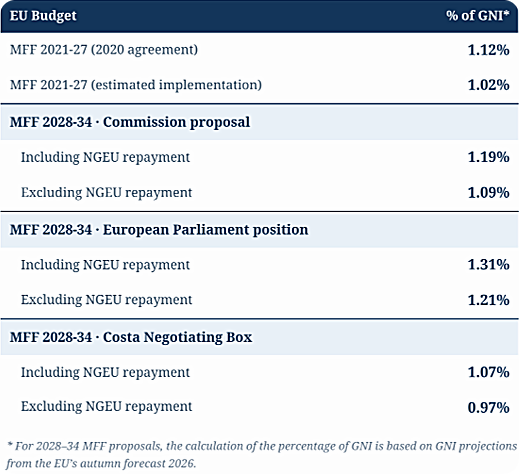
Where does this leave the size of the next MFF compared to the one that is in place? By far, the most interesting comparison is how much of Europe’s economic might can be spent by the EU: how big is the MFF as a percentage of Gross National Income (GNI) (Table 1)? Naturally, this is also the best predictor of how national contributions will change as a share of national income.
By this measure, the frugals have already won. As our EU Budget Navigator shows, the Costa box implies an MFF of 1.07% of GNI based on newest forecasts. This is significantly below the 1.12% agreed in 2020 for the current MFF.
As Covid and the war against Ukraine brought unexpectedly high inflation, the actual turnout of the current MFF will likely be around 1.02%, which is below the Costa box. That decline, however, was pure luck for member states’ treasuries and does not change the fact that member states agreed to a bigger MFF in 2020 than the figure Costa has now put on the table.
The picture gets worse when we account for Next Generation EU (NGEU), the Covid recovery programme. First, of course, the EU’s spending capacity from 2021 to 2027 was far bigger than the MFF as NGEU massively increased the EU’s financial firepower. Second, repayment for NGEU is poised to begin in 2028. In 2020, Council and Parliament agreed that the debt service for NGEU should not reduce the size of future EU programmes. If one subtracts these costs from the Costa box, the size of the MFF for actual spending stands at a meagre 0.97% of GNI – less than the current MFF, even after its share of GNI shrank due to inflation.
One caveat here is important for completeness – the debt service cost for the loans made to Ukraine is not part of the size of the MFF as it is dealt with above the MFF ceilings. How to best use the EU budget infrastructure to support Ukraine in the next MFF period remains one of the most important open points that the Costa box does not properly address. That means we are left to guess.
As the EU will have to pay at least about 50 billion euros in interest on loans to Ukraine over the MFF period, this adds 0.03 percentage points back to the envelope. With this correction, the Costa box still ends up below the last agreement. Without NGEU debt service, the EU’s financial capacity still only reaches exactly 1% of GNI. This number could of course increase substantially if the war continues.
However, it is questionable whether we should include support for Ukraine in the first place when assessing the EU’s financial firepower. There is a reason why this support is included above the MFF ceilings. Using the EU’s budget infrastructure is simply the most efficient way to channel support to Ukraine. The counterfactual when reducing support to Ukraine in the EU budget would not be lower costs for the member states, but instead they would need to shoulder the bill bilaterally, probably at higher costs.
Table 1. Based on the Costa box, the next EU budget will be smaller than the agreement on the current budget.
2. The cuts hit Europe’s capacity to act
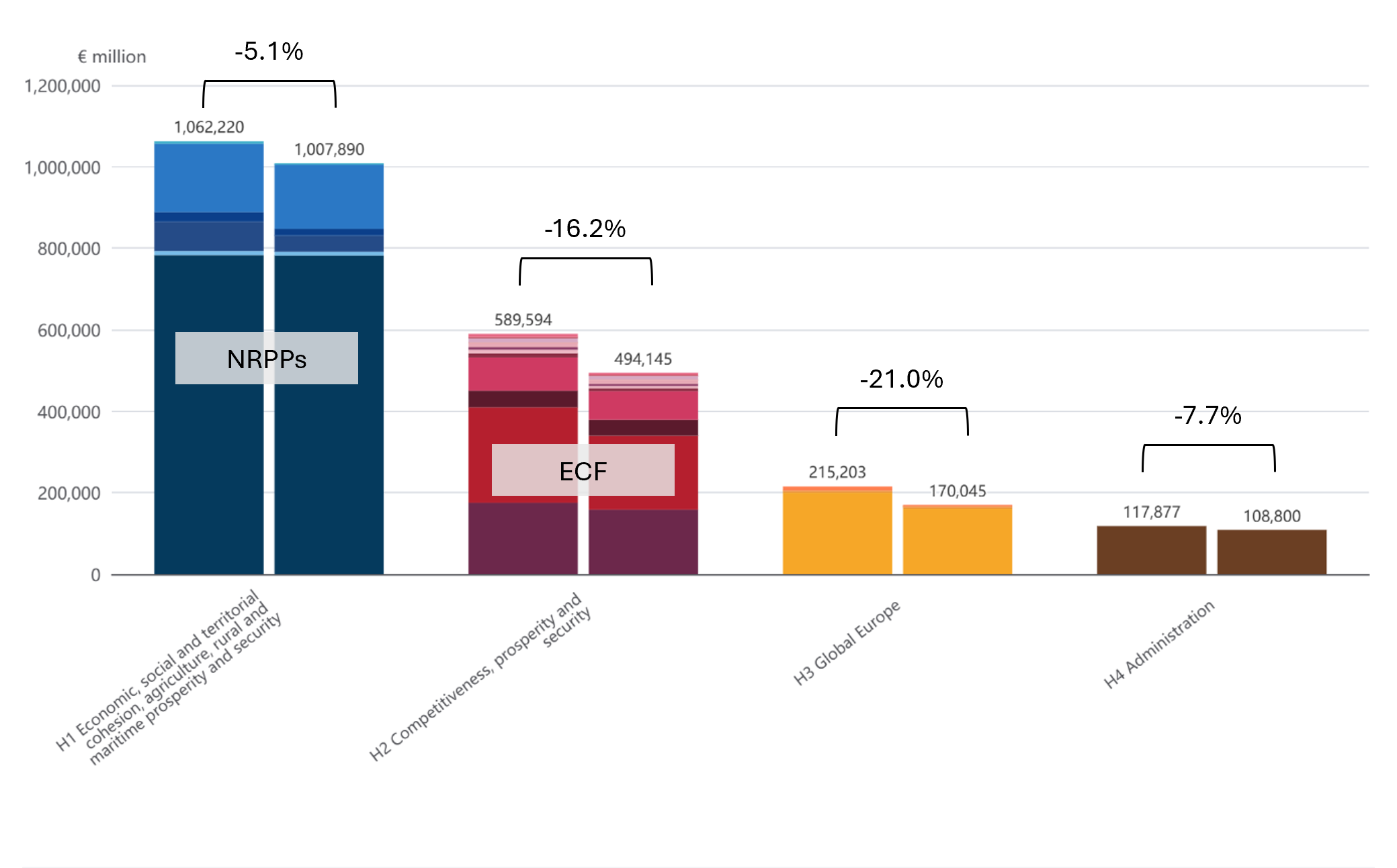
The Costa box understandably tries to square the circle by cutting where it ostensibly hurts member states least. It leaves the allocations for member states in the National and Regional Partnership Plans for cohesion and agricultural policy fully intact (-0.1%). Cuts in the first heading for traditional spending areas amount to roughly 5% overall, but they are overwhelmingly driven by a slower repayment of NGEU. At the same time, the proposal cuts heavily into the pots for innovation (-16.2%) and global engagement (-21.0%) (Figure 1).
This repeats a familiar pattern of MFF negotiations whereby member states fiercely protect the money they are guaranteed to receive in the traditional funds. In turn, they let the funds bleed that are either distributed in competitive processes so that member states do not know in advance how much they will receive, or that flow to third countries, only benefiting member states indirectly.
This means the funds that the EU can spend jointly over the MFF’s seven-year horizon get smaller and smaller, while an increasing part of the MFF is pre-distributed to member states with virtually no chance of reassigning it later to new priorities. In the Commission proposal, national allocations represented 41.7% percent of the total volume.
The Costa box has already increased this number to 45.5% and we can expect it to increase further during the negotiations if no member states take charge of defending the EU’s capacity to act, which has been significantly strengthened by the Commission in its proposal. In particular, this could be the new mission for the frugals, all the more because they usually stand more to gain from excellence-based pots such as Horizon.
Figure 1. Cuts primarily target new priorities and external action in the second and third heading. This figure is comparing the Commission proposal (to the left) with the Costa box (to the right).
 3. The revolution is still on
So far, all-too-familiar patterns have been described. But we should not lose sight of a very positive development: The Costa box preserves the main architectural features of the Commission proposal. Indeed, they do not even seem to be controversial within the Council anymore. This means that the next MFF will represent nothing short of a revolution.
The impenetrable maze of competing and overlapping programmes to fund all kinds of priorities at the EU level will give way to a much more transparent structure, with the number of programmes shrinking from about 50 to about 20. The weight given to common spending over national allocations will – despite the aforementioned cuts – still increase significantly as national allocations shrink from 64.1% percent in the current MFF to 45.5%.
This simplified structure will drastically increase the EU’s flexibility to adjust spending to shifting priorities and react to crises. This is essential for a seven-year budget that has previously been restrained by rigidity. To preserve this feature, it is key that flexible amounts are not eaten up by excessive earmarking as negotiations proceed, as, for instance, proposed by the European Parliament.
Moreover, with the new National and Regional Partnership Plans, for the first time, member states will have to explain comprehensively how they spend their pre-allocated national envelopes – and be reviewed by the Commission for the whole package. So far, these funds have been spent via multiple programmes at different levels of governance with distinct review mechanisms. As a result, they lacked comprehensive oversight. The new system could pave the way for much more accountability and transparency on how EU money is spent.
Finally, there is a chance that for the first time, the EU receives significant new funding sources via new own resources. The Costa box suggests a digital tax on top of several Commission proposals – CBAM, a levy on non-recycled e-waste, a tobacco levy and ETS1. These revenue sources would make the EU budget a bit less dependent on the blunt member state contributions based on GNI. This is a significant step towards diversifying the EU budget’s funding sources.
At the same time, own resources are no panacea to alleviate the dependence on financing by member states. Practically all proposed own resources beyond the digital tax and CBAM are effectively transfers of national tax revenue to the EU level, so they just modify the distribution of the financial burden. Still, the direction of travel is the right one.
4. It ain’t over ’til it’s over
We are entering the final stretch of the MFF negotiations. But it is very important to keep in mind that the negotiations in the European Council are only the first – albeit by far the most important – act of the grand finale. Its conclusion will be followed by negotiations with the European Parliament. However, the Parliament has a wildly different starting position for these negotiations as it strongly resists structural changes in the budget and wants an MFF of 1.21% of GNI based on latest forecast – and that does not include the debt service for NGEU.
This is a very familiar pattern. The Parliament often starts with very high expectations, but the Council’s unanimity requirement has always made it very difficult for the Parliament to re-open the summit agreements in earnest. In this cycle, it looks like the trilogue may be a little more challenging since the European Parliament is particularly fragmented. As we can only expect a slim majority to pass the next MFF, a handful of MEPs might be able to block an agreement and send it back to Council to be renegotiated with a new French president. However, in general, the same structural pressure will apply to this Parliament that has applied to every Parliament before it.
However, one thing is different this time. The French and Polish elections have a realistic chance of yielding new governments that will not feel bound by a prior European Council agreement on the MFF. That matters because for a new MFF to work, the new own-resources decision will have to be ratified by national parliaments. And there is no realistic way that this will happen before at least the French elections. This is not an argument to wait with a deal – the current MFF runs out at the end of 2027 and it would be reckless to pause negotiations until next summer. But the chance that such an agreement will be derailed again in the Council itself is much higher than in previous periods.
What’s next?
With Costa’s negotiating box, the next MFF is moving closer to an agreement. The Commission’s revolutionary overhaul of the budget’s structure looks pretty set. Through massive cuts and new revenue proposals, Costa now hopes to win over key member states on the remaining sticking points: the budget’s size and how to finance it.
The frugals have largely won the argument over the size of the EU budget – it will account for a smaller share of the EU’s economic power than the current budget when adopted. Now, the primary question is how we spend the remaining money. So far, cuts fall almost exclusively on new priorities such as competitiveness, defence and security, while envelopes for agriculture and cohesion are largely preserved. But the smaller the EU budget is, the more essential it is to focus funding on where EU spending can achieve the most added value.
That makes the next stage of the negotiations all the more important. The frugals now have to choose what matters most to them between further cuts, swift NGEU repayment, rebates and modernising the budget’s spending priorities. At the same time, the Friends of Cohesion and in-betweens, such as France, face a similar choice. Are they open to allow cuts in the pots dearest to their hearts to keep the size of the budget? We could be in for a November surprise if everyone moves just a bit – or we could see a protracted negotiation well into next year.
About the authors
Lucas Guttenberg heads our Europe programme as its Director. His research focuses on the EU budget, EU economic and fiscal policy coordination, Germany’s role in the EU and the Franco-German relationship.
Anna Heckhausen works in the Europe programme at the Bertelsmann Stiftung, focusing on issues related to the EU budget.



Kommentar schreiben