

Germany and five other Member States are calling for substantial cuts to the EU’s next long-term budget while stressing the need for investment in competitiveness, security and defence. Meanwhile, other governments want to protect established spending on agriculture and cohesion. This sets the stage for a tense stand-off with much at stake for the future of the European Union.
Over the coming three months, Member States will try to square this circle and reach an agreement on the next Multiannual Financial Framework (MFF) by the end of the year. The new EU Budget Navigator shows the trade-offs they face between limiting the overall size of the budget and national contributions, protecting established programmes, and financing new European priorities.
The next EU budget will have to do more
Demands on the EU budget are ever increasing. Competitiveness, support for Ukraine, defence and security, migration, economic transformation and enlargement all require additional funding. At the same time, agriculture and cohesion are poised to absorb a large share of the EU budget as in previous funding periods. On top of this, the EU is due to begin repaying the debt issued to finance the NextGenerationEU recovery programme during the Covid-19 period.
Yet the EU budget remains small compared with national budgets. Relative to gross national income, it is roughly one-tenth the size of Germany’s federal budget. Therefore, negotiations on the next Multiannual Financial Framework (MFF) will force governments to decide on common priorities, do they want to make the best use of the EU’s limited resources.
The debate comes down to three options: Governments can increase national contributions to fund all their priorities; reduce spending on established programmes; or scale back some of the EU’s new ambitions. Whichever option Member States choose in the coming months will shape the EU’s capacity to act well into the next decade.
The EU Budget Navigator makes these trade-offs visible. It allows users to compare the positions of the Commission, Parliament and Council, examine the underlying figures and explore alternative budget scenarios.
How to use the EU Budget Navigator
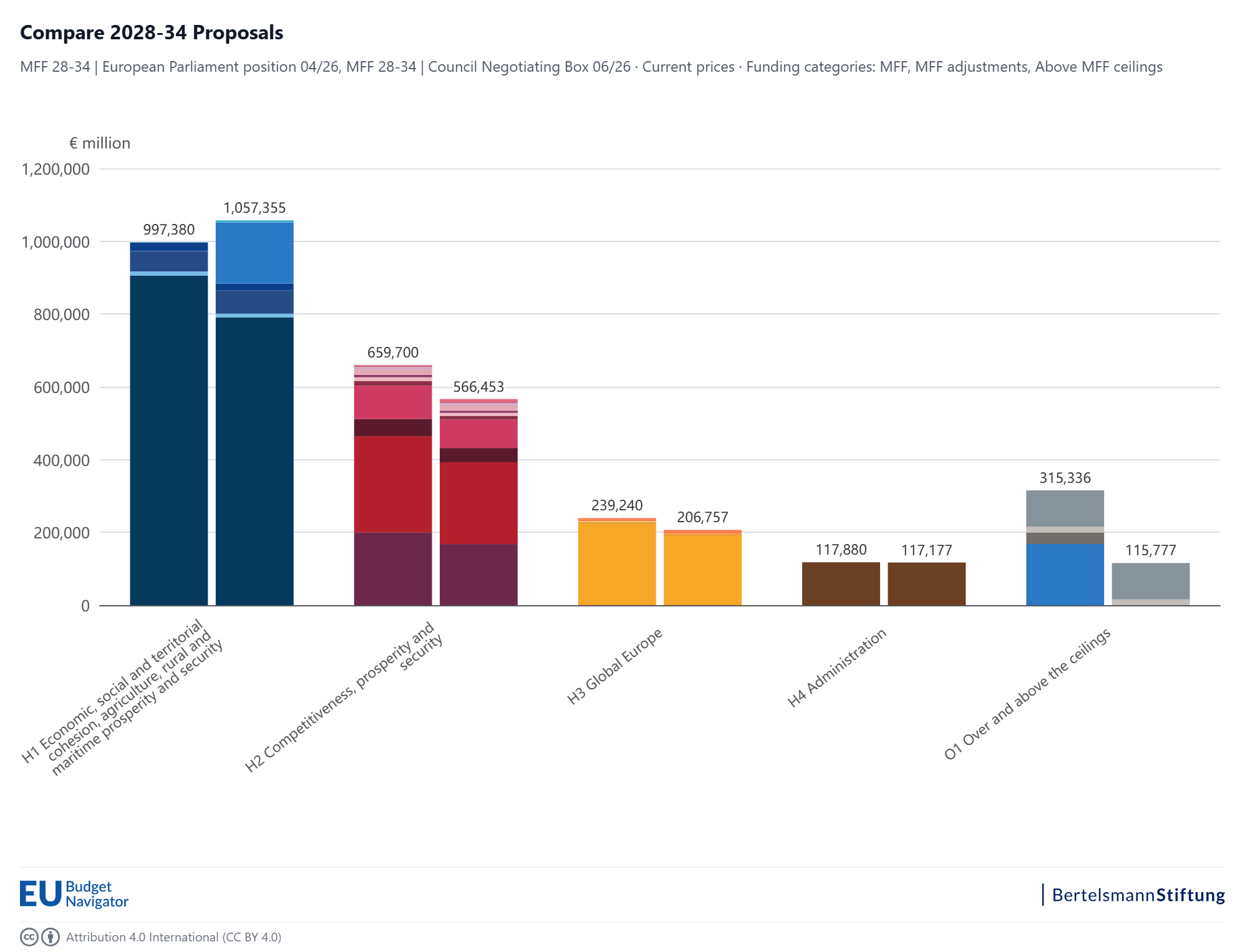
The EU Budget Navigator brings the main budget positions together in a common framework. Users can compare the current 2021-2027 MFF with the proposals for 2028-2034 from the European Commission, the European Parliament and the Council. The comparisons show not only how the overall size of the budget would change, but which policy areas would gain or lose funding.
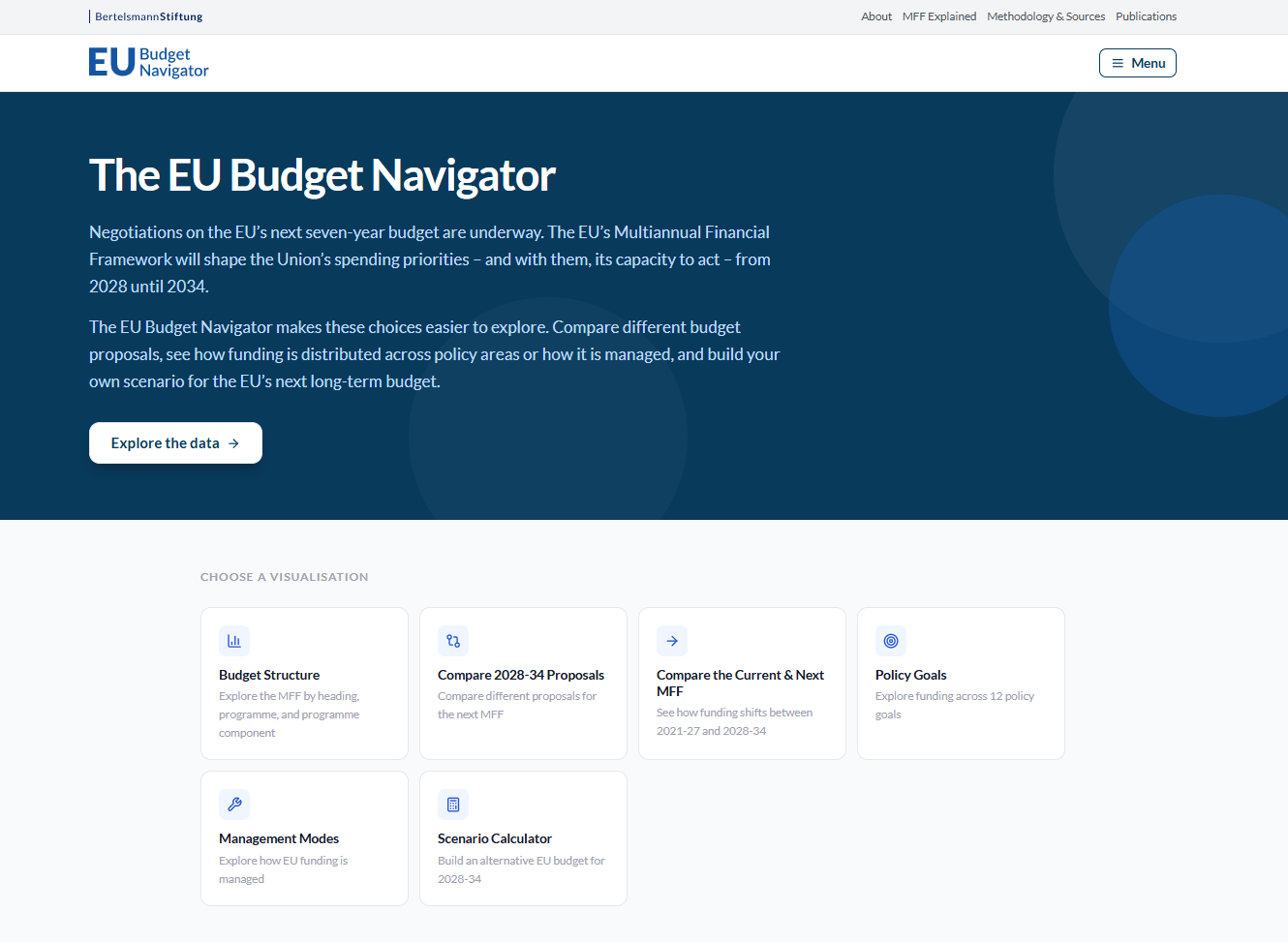
Five interactive charts allow users to explore the data by budget heading, programme, policy goal and management mode. For example, they can examine how much funding is allocated to competitiveness or cohesion, whether it is managed centrally or jointly with Member States, and how priorities differ across proposals and budget periods.
• Budget Structure: Explore the MFF by heading, programme and programme component
• Compare 2028-34 Proposals: Compare different proposals for the next MFF
• Compare the Current and Next MFF: See how funding shifts between 2021-27 and 2028-34
• Policy Goals: Through its programmes and instruments, the EU pursues a wide range of objectives – explore funding across 12 policy goals
• Management Modes: Explore how EU funding is managed – directly or indirectly – by the European Commission, decentralised agencies or third parties, or under shared management with Member States
The Scenario Calculator goes one step further. Users can construct their own budget for 2028-2034, adjust allocations across policy areas and compare the result with the proposals on the table. This makes the underlying trade-offs more concrete – increasing expenditure in one area requires either additional resources or lower spending elsewhere.
The Navigator covers the 2021-2027 MFF, as agreed in 2020 and as implemented by July 2025, alongside the available positions for 2028-2034. New Council positions and changes to Parliament’s position will be added as the negotiations progress.
Explore the EU Budget Navigator here.
What has happened so far
1. The Commission proposes a larger and more flexible budget
The European Commission presented its proposal for the 2028-2034 MFF in summer 2025. The proposed budget amounts to 1.26% of EU gross national income, including 0.11% for NextGenerationEU debt repayments. By comparison, the current framework amounts to 1.12% of EU GNI.
The Commission proposed simplifying the budget’s structure by combining programmes that are currently managed separately into larger funds. National and Regional Partnership Plans would bring together much of the funding for cohesion policy, agriculture, fisheries, migration and internal security. A new European Competitiveness Fund would place 14 programmes under a common set of rules.
This new architecture is intended to make the budget more flexible, but the proposed changes are politically contentious. Larger funds and national plans would give Member States more scope to shift resources between priorities, tailor investments to national needs and respond to new challenges. At the same time, greater flexibility could reduce predictability for beneficiaries and make it more difficult to safeguard long-term investments.
The proposed shift in spending priorities reflects how much Europe’s political environment has changed since the current budget was negotiated. Russia’s war against Ukraine, intensifying competition from China and growing concerns about economic security have created a particularly difficult context for the negotiations.
2. Recent positions reveal the main political divide
Following the Commission’s proposal, the European Parliament adopted its negotiating position in April 2026. Parliament supports greater investment in competitiveness, defence, research and infrastructure, but not at the expense of established spending on agriculture and cohesion. As a result, it calls for a larger budget than the Commission has proposed: programme expenditure equivalent to 1.27% of EU GNI, with a further 0.11% for NextGenerationEU repayments placed outside the main spending ceilings.
Additionally, Parliament wants agriculture, cohesion, fisheries and the European Social Fund to retain separate, protected allocations. It is concerned that grouping these policies within large national plans would reduce transparency, weaken parliamentary oversight and give national governments too much discretion to shift funding between priorities.
Member States have not yet agreed on the overall size of the budget. On individual programmes, Council positions adopted so far broadly support the simpler architecture proposed by the Commission, combined with greater national control over programming and implementation.
A negotiating document presented by the Cyprus Council Presidency in June included a provisional total of €1.73 trillion in 2025 prices. Its limited cuts would fall primarily on competitiveness, defence and external action, while leaving agricultural and regional spending largely intact. But these figures did not represent an agreed Council position and several frugal Member States immediately rejected the proposal as a non-starter.
The divisions between Member States became clearer in August 2026. Germany, Denmark, the Netherlands, Austria, Finland and Sweden called for the Commission proposal to be reduced by several hundred billion euros. At the same time, they identified competitiveness, security and defence, migration and sovereignty as key priorities. Unlike the approach outlined by the Cyprus Presidency, their demands would require substantial reprioritisation within a considerably smaller overall envelope.
3. The negotiations will heat up in the final quarter of 2026
EU leaders aim to reach a political agreement by the end of 2026. The MFF must be adopted unanimously by the Council and it requires the consent of the European Parliament. An agreement among Member States in 2026 would leave the following year for negotiations with Parliament and the adoption of individual programmes before the new budget period begins on 1 January 2028.
The timetable is particularly important because several Member States, including France, Italy and Poland, are due to hold major elections in 2027. If the EU budget becomes part of national election campaigns, it could become even more difficult for EU leaders to reach a compromise.
As negotiations gather pace and new figures are put on the table, keeping track of the negotiations is becoming increasingly difficult. The EU Budget Navigator aims to address this issue.
About the author
Anna Heckhausen works in the Europe’s Future programme at the Bertelsmann Stiftung, focusing on issues related to the EU budget. Her research centres on the next Multiannual Financial Framework (MFF 2028-2034), particularly on budget sustainability and the green transformation of Europe’s economy.




Kommentar schreiben