
Lessons from the Middle East and North Africa on Turning Fragmentation into Strategic Leverage
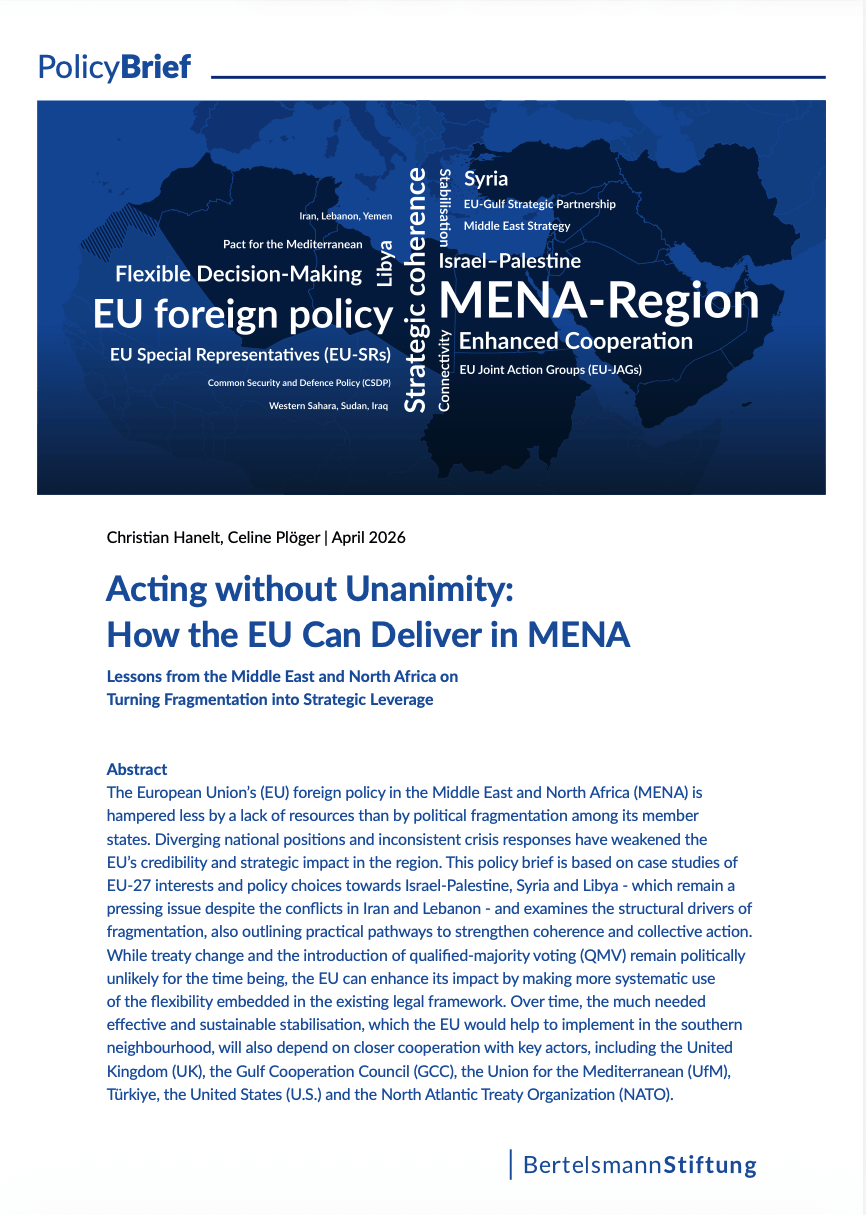
The European Union’s (EU) foreign policy in the Middle East and North Africa (MENA) is hampered less by a lack of resources than by political fragmentation among its member states. Diverging national positions and inconsistent crisis responses have weakened the EU’s credibility and strategic impact in the region. This policy brief is based on case studies of EU-27 interests and policy choices towards Israel-Palestine, Syria and Libya – which remain a pressing issue despite the conflicts in Iran and Lebanon – and examines the structural drivers of fragmentation, also outlining practical pathways to strengthen coherence and collective action.
While treaty change and the introduction of qualified majority voting (QMV) remain politically unlikely for the time being, the EU can enhance its impact by making more systematic use of the flexibility embedded in the existing legal framework. Over time, the much needed effective and sustainable stabilisation, which the EU would help to implement in the southern neighbourhood, will also depend on closer cooperation with key actors, including the United Kingdom (UK), the Gulf Cooperation Council (GCC), the Union for the Mediterranean (UfM), the United States (U.S.) and the North Atlantic Treaty Organization (NATO).
Core recommendations:
1. Make better use of European Union Special Representatives (EU-SRs) to enhance presence, impact and sustained diplomatic leadership: Assign new and strengthen existing mandates; increase continuous political backing by EU member states; increase resources (stronger multinational teams and EU delegations); follow the positive example of the EU-SR for the Gulf, and set-up EU-SRs to help solve conflicts in Syria and Libya.
2. Treat CSDP missions as core delivery tools for stabilisation: Employ more consistently and efficiently civilian and military Common Security and Defence Policy (CSDP) missions and operations (after a review of experiences with running missions): security sector reform, border management, maritime security; mobilize enough money and staff; EU member states may ensure clearer and stronger executive mandates – more adaptive to complex conflict environment. E.g.: scale-up the CSDP mission in Libya for Institutional Reform and Rule of Law.
3. Combine economic and connectivity instruments to a consolidated strategy: Align the Pact for the Mediterranean, the EU co-chair role of the Union for the Mediterranean (UfM), the EU-Gulf Strategic Partnership, Global Gateway, and Team Europe Initiatives more strategically (an envisaged new EU-Middle East strategy can serve into this direction) to reinforce stabilisation, diversification, interconnectivity across the Mediterranean and regional cooperation within the MENA region. E.g.: Syria interconnected infrastructure projects of the EU with the GCC should be designed to also contribute to inclusive, good and efficient governance; encourage EU member states to channel their funds via EU budget lines in EU Commission projects to increase their impact; enlarge the focus of trade agreements with a strong investment angle.
4. Revert to more flexible decision-making to prevent paralysis and regain agency: Groups of EU member states willing to engage sustainably in resolving a conflict should be encouraged by the High Representative/Vice-President (HR/VP) and the Council President to form EU Joint Action Groups (EU-JAGs/”coalition of the willing”) – modelled on the E3/EU cooperation on the Iran file (before Brexit). These EU-JAGs would support the HR/VP and the EU Special Representatives (EU-SRs) while maintaining political momentum and safeguarding EU coherence and credibility. E.g.: regarding the sensitive Israeli-Palestinian conflict: An EU-JAG mirroring the spectrum of different views of EU member states from Ireland to Lithuania and from Spain to Bulgaria could increase EU impact with the conflict parties in support of the HR/VP and her EU-SR. In general: The MED9 group can serve as an initiator, facilitator and promoter of the implementation of joint EU activities in the Mediterranean/
MENA region.
The EU’s Resilience Runs Through MENA
In an increasingly competitive geopolitical environment – further complicated by the wars and conflicts in Europe’s neighbourhood, from Ukraine to Lebanon and Iran – the European Union’s (EU) resilience depends on reducing vulnerabilities and diversifying partnerships. The EU has already been going down this path by defining the Agenda for the Mediterranean and its EU-Gulf Strategy in 2022. Apart from promoting stability, international climate policy has also been a key driver behind efforts to encourage nearshoring and create win-win situations for the economic development of our southern neighbours. Such initiatives can also help address pressing needs by providing young people with a job perspective, thus reducing the risk of irregular migration and the spread of extremism/terrorism.
Today, the southern neighbourhood remains at the centre of European strategic thinking, with the Pact for the Mediterranean recently adopted. From energy diversification and trade routes to economic stabilization and migration governance, cooperation with the Middle East and North Africa (MENA) has become a structural requirement rather than a matter of regional crisis management. The Pact for the Mediterranean and the new Union for the Mediterranean (UfM) vision document – both decisively shaped by the EU – signal strategic ambition. They outline a coordinated, long-term framework linking economic cooperation, connectivity, and investment with stability and security. Yet ambition meets a region defined by protracted conflicts, governance breakdowns, geopolitical rivalries, and humanitarian crises. With ten active conflicts, instability directly disrupts connectivity initiatives, deters investment, and weakens economic prospects. At the same time, divergent national priorities, energy interests, domestic constraints, and competing threat perceptions fragment the EU’s response. The Union has a strategy on paper and instruments at its disposal; yet what remains insufficient is the political cohesion to use them more effectively and to see them through. These spillover effects and shortcomings of a joint and sustainable European response were also evident around the US-Israel-Iran war in the spring of 2026.
Flexible CFSP Engagement in the MENA Region
In the MENA region, where divisions among EU member states often impede common action, the EU should make more strategic use of the flexibility already available in the treaties. European Union Special Representatives (EU-SRs) under Article 33 TEU can provide continuity, visibility, and sustained diplomatic engagement in conflict settings where fragmented national initiatives have proved insufficient; importantly, their appointment by the Council is one of the few Common Foreign and Security Policy (CFSP) decisions that may be taken by qualified majority voting (QMV) under Article 31(2) TEU, which makes the instrument especially valuable when unanimity is politically difficult.
Alongside EU-SRs, the EU could rely more systematically on smaller, mission-oriented groupings of willing member states, here described as EU Joint Action Groups (EU-JAGs), as an operational form of differentiated cooperation within the CFSP, particularly when coordinated by the High Representative of the Union for Foreign Affairs and Security Policy/Vice-President of the European Commission (HR/VP) and/or linked to an EU-SR mandate. In legal terms, constructive abstention under Article 31(1) TEU remains the most practical flexibility mechanism, whereas enhanced cooperation under Article 20 TEU and Articles 326–334 TFEU is available in principle but harder to use in foreign policy because authorization in the CFSP field requires unanimity under Article 329(2) TFEU. Informal formats such as MED9, while not formal EU instruments, show how likeminded Mediterranean member states can pre-coordinate positions, build momentum on southern neighbourhood issues, and reinforce wider EU engagement.
Constraints to EU Action: Agreements on Ends, Divergence on Means
The political fragmentation is reflected in how EU member states interpret priorities, threats, and instruments in the MENA region. To capture these differences systematically, the analysis draws on the EU-MENA survey, an expert survey conducted across all 27 EU member states. The findings illustrate how shared strategic goals coexist with distinct national interpretations.
Across the Union, member states converge on overarching objectives — regional stability, conflict prevention, economic resilience, migration management, and respect for international law — yet pursue them through distinct national lenses. Some adopt a humanitarian perspective (e.g. IE, LU, MT, BE), prioritising civilian protection and normative commitments; others emphasise deterrence and security (e.g. PL, EE, LT, RO, BG), focusing on Iranian influence, Russian involvement, counterterrorism, and hybrid threats; still others approach the region primarily through a migration-management lens (e.g. IT, EL, CY, AT, DK), stressing border control, return policies, and cooperation with transit states. These perspectives shape conflict interpretations: Israel-Palestine is framed by some as a moral and historical issue, by others as a security challenge, while Syria and Libya are seen either as humanitarian crises or migration concerns. For several EU member states, NATO remains the principal framework for deterrence and crisis response, reducing incentives to strengthen EU-only instruments. Fragmentation thus reflects divergent pathways to stability rather than disagreement over ultimate goals.
The survey nevertheless indicates considerable support for more flexible EU decision-making. More than 60% of respondents endorse the idea of groups of countries advancing in taking decisions and getting into action (EU-JAGs), provided they are conducive to CFSP policies and priorities under the coordination of the HR/VP and in support of designated EU-SRs under HR/VP supervision. This points to political appetite for more flexible procedures within the CFSP, in line with the Treaties, which could have immediate effect in relation to Israel-Palestine, Syria, and Libya.
This is all the more important as a significant credibility gap constrains EU influence. Around 70% of respondents consider that the EU applies international law and human rights more consistently in Ukraine than in MENA conflicts, with the perceptions of “double standards” being particularly pronounced in the Israel-Palestine context. Without greater consistency, even flexible cooperation formats are unlikely to generate sustained impact. Credibility, in this sense, is not abstract: inconsistent behaviour directly weakens the EU’s ability to advance the impact of the Pact for the Mediterranean, the UfM agenda and the EU-Gulf Strategy, maintain partnerships with the United Kingdom (UK), the Gulf Cooperation Council (GCC), Türkiye, the United States (U.S.), NATO, the League of Arab States (LAS), and the African Union (AU), and exercise leverage in conflict mediation.
Fragmentation in Practice: EU Policy in Israel–Palestine, Syria, and Libya
The consequences of divergent national lenses beyond the conflicts/wars regarding Iran and Lebanon are most evident in three conflicts that test the EU’s cohesion and credibility in its direct southern neighbourhood: Israel-Palestine, Syria, and Libya. At the same time, these conflicts highlight untapped potential for more effective EU engagement, underscoring that the challenge lies less in institutional capacity than in political coordination.
Israel–Palestine: Credibility, Consistency, and the Limits of EU Unity
The Israel-Palestine conflict most starkly exposes the tension between the EU’s normative commitments, political interests, and domestic constraints. Nowhere is European fragmentation more visible – or more consequential for the Union’s credibility.
Several structural drivers explain why this conflict divides the EU more than others. For some EU member states, historical responsibility for Israel’s security remains a central reference point, shaping policies that prioritise Israel’s security narratives and regional position (e.g. DE, CZ, HU).
Others emphasise humanitarian imperatives, particularly in Gaza, and the primacy of civilian protection and international humanitarian law (e.g. IE, LU, MT, ES). Domestic political sensitivities – including the importance of Jewish and Muslim communities and concerns about rising radicalisation, antisemitism, and anti-Muslim sentiment since October 7, 2023 – further shape national positions. Economic, technological, and defence ties with Israel, as well as alignment with U.S. Middle East policy in the context of broader security concerns vis-à-vis Russia (e.g. LT, PL), add additional layers of divergence.
Importantly, all EU member states formally support a two-state solution. Fragmentation arises less from disagreement over the end goal than from diverging priorities, sequencing, and willingness to apply political and economic carrots and sticks. The result is inconsistent signalling and diminished EU leverage with both Israeli and Palestinian actors.
Three Levers for Greater Coherence
First, implement agreed EU positions more consistently. European Council conclusions already provide a clear policy baseline, including support for a two-state solution, humanitarian access, opposition to settlement expansion, and accountability under international law. More consistent implementation – regarding settlement activity, disarmament of radical groups, security guarantees, reconstruction and governance reform – would strengthen the EU’s credibility. Using the UfM framework for these purposes should also be considered since Israel and Palestine are equal members in this regional Mediterranean institution.
Second, more flexible decision-making and advancing of action. Encouraging a group of willing EU member states (EU-JAG) to demonstrate political commitment and advance on joint activities would help strengthen the work of the HR/VP and EU-SR for the Middle East Peace Process. Such an action group would allow willing EU member states to demonstrate sustainable political commitment while preserving overall EU unity and could help operationalise the forthcoming EU Middle East Strategy. Bulgaria and the Netherlands are suggested to be a part of such an EU-JAG since their former ministers of defence/finance are members of the interim governance structure for Gaza.
Third, restore credibility through equal standards and regional embedding. Perceptions of “double standards” – particularly in comparison to Ukraine – undermine the EU’s normative authority. A consistent pro-peace stance requires balanced diplomatic engagement with Israeli and Palestinian institutions, business communities and civil society organisations, principled application of international law (including smart engagement with the International Criminal Court), and sustained support for legitimate Palestinian governance in view of the two-state solution. Embedding conflict engagement within wider regional cooperation – including Jordan, Egypt, the GCC states and the League of Arab States – can further enhance EU influence. Platforms such as the UfM, co-chaired by the EU, offer additional avenues to address the regional dimensions of the conflict.
Syria: When Consensus Exists but Political Follow-Through Falters
Syria presents a paradox. Among the major MENA conflicts it is the one where European consensus has been strongest, yet where sustained, coordinated political engagement has repeatedly stalled. The case illustrates that unanimity alone does not guarantee strategic coherence.
For more than a decade, the EU maintained a largely unified approach centred on humanitarian support, protection of refugees, and backing the UN-led political process under UN Security Council Resolution 2254. This consensus translated into substantial collective engagement, including annual Brussels Conferences, sustained financial support through dedicated trust funds, and a coordinated sanctions policy. Following the fall of the Assad regime, the EU again reacted swiftly: guiding principles for engagement were defined, sanctions were lifted, and high-level diplomatic outreach was coordinated under the authority of the HR/VP.
Yet this early momentum quickly dissipated. The Syrian case exposes the limits of reactive unity in the absence of sustained political leadership and institutional anchoring. Agreement on principles did not translate into a long-term European strategy.
Several structural dynamics continue to shape EU engagement. Refugee movements and diaspora communities influence domestic politics across multiple EU member states, particularly regarding return policies. Divergent approaches to repatriation persist, ranging from active encouragement of returns to strong legal and humanitarian reservations. Reconstruction and economic engagement remain politically sensitive in the absence of a credible political transition. At the same time, counterterrorism concerns – including
residual “ISIS” networks – remain acute, while concern of recurring Iranian and Russian influence is widely viewed as destabilising, especially in context of the withdrawal of all U.S. troops. Regional rivalries, particularly involving Türkiye and Israel, further complicate the strategic environment. Uncertainty surrounding constitutional reform and political transition continues to limit the EU’s room for manoeuvre.
In short, Syria demonstrates that consensus on objectives – humanitarian protection, stabilisation, counterterrorism – does not automatically produce sustained strategic engagement.
Three Priorities for a More Durable EU Approach
First, anchor political leadership. While a High-Level Political Dialogue and the reinstatement of the 1978 Cooperation Agreement are planned, a dedicated EU-SR for Syria, operating under the authority of the HR/VP, could provide continuity and strategic focus. Such a mandate would help translate broad consensus into sustained diplomatic engagement, coordinate member state initiatives, and serve as a focal point for dialogue with regional and international actors. An EU-JAG could help reinforce this effort and support the proposed EU-SR without undermining overall EU unity.
Second, link stabilisation support to inclusive governance. Even under political constraints, targeted development and stabilisation instruments can foster local resilience and mitigate renewed fragmentation. Priorities include restoring basic services, supporting local economic recovery, and encouraging inclusive governance structures that integrate ethnic and religious minorities. A calibrated approach – sometimes described as “critical engagement” – allows reconstruction-related assistance while maintaining political conditionality linked to rule-of-law standards and institutional reform.
Third, embed Syria policy in regional partnerships. Given the financial and political weight of Gulf Cooperation Council (GCC) states and the central role of regional actors such as Türkiye and Israel, effective EU engagement requires structured regional coordination. The EU-GCC framework and Team Europe Initiatives offer avenues to align stabilisation funding and political messaging. Coordinated engagement can also strengthen leverage vis-à-vis the Syrian transitional authorities, particularly regarding inclusive governance, security sector reform, and the integration or demobilisation of armed groups. Where appropriate, a civilian CSDP mission could support institutional reform in areas such as policing and rule of law.
Libya: Geopolitical Proximity and the Cost of Competing Agendas
Libya is the conflict where European strategic interests intersect most directly. Geographic proximity, energy interdependence, migration pressures, and maritime security concerns make Libya a core European file. Yet national agendas, particularly between France and Italy, have long prevented a sustained and unified EU approach.
Since the fall of Muammar Gaddafi, overlapping energy interests, diverging migration strategies, and competing alignments with external actors have reinforced Libya’s internal fragmentation between eastern and western authorities. A brief moment of European convergence emerged in 2013 with the launch of the European Union Border Assistance Mission in Libya (EUBAM Libya) and then again 2020, when Germany helped convene the Berlin Process and support the United Nations Support Mission in Libya (UNSMIL). But this momentum faded. Short-term stabilisation masked unresolved structural tensions, while external actors – including Russia, Türkiye, the United Arab Emirates (UAE), Egypt, and Qatar – deepened their influence.
Libya’s instability has direct consequences for Europe. Energy infrastructure and prospective interconnectors are central to diversification strategies. Migration movements across the central Mediterranean remain politically sensitive. Maritime security is closely tied to developments along the Libyan coast and the presence of foreign military actors. At the same time, the country’s economic potential – in logistics, ports, renewable energy, and reconstruction – remains largely untapped due to political division and weak governance. The duplication of institutions between east and west continues to paralyse decisionmaking and drain resources, while everyday hardships – electricity shortages, water supply disruptions, inflation, delayed salaries – erode public trust and fuel instability.
Libya is therefore not only a security concern but a test of whether the EU can translate shared priorities into coordinated geopolitical leadership.
Three Shifts toward European Coherence
First, consolidate political leadership at EU level. The experience of the Berlin Process demonstrates that coordinated diplomacy can generate momentum when EU member states align behind a common framework. Reinvigorating such coordination requires anchoring political responsibility at EU level. The designation of a dedicated EU-SR for Libya, supported by an EU-JAG, could help overcome national rivalries, ensure continuity of engagement, and restore European visibility in multilateral processes.
Second, focus on stabilisation that improves daily life. European engagement should prioritise tangible improvements in basic services – electricity, water, public administration – while carefully avoiding actions that entrench political division. Existing CFSP instruments, including EUBAM Libya, could be adapted to support broader rule-of-law and administrative reform efforts. Delivering visible benefits to citizens is essential to rebuild trust and reduce incentives for renewed fragmentation.
Third, deploy economic and connectivity instruments strategically. Libya is well suited for a more assertive use of European economic and development tools, including Global Gateway investments in energy and transport connectivity. Linking Libya’s infrastructure more closely to European networks – for example through electricity interconnectors and port development – would anchor the country economically while supporting diversification and regional integration. Such engagement should be embedded within wider Mediterranean frameworks, including the UfM, and aligned with structured cooperation with GCC partners where appropriate.
From Capacity to Coherence: Four Priorities for EU Action
The case studies point to a common conclusion: the EU’s limitations in the Middle East and North Africa (MENA) region stem less from a lack of instruments than from insufficient political alignment and inconsistent strategic follow-through. Treaty-based tools for diplomatic leadership, operational presence, economic leverage, and flexible cooperation already exist. The challenge lies in deploying them coherently and with sustained political backing.
In a contested MENA landscape, credibility will depend on delivery. The EU’s challenge is no longer to design instruments but to use them with political resolve. Inaction, not diversity, is the real strategic risk. Four priorities, drawn from the case studies, should guide this effort.
(1) Make better use of European Union Special Representatives (EU-SRs): guarantors for a sustained EU presence in conflict resolution. EU-SRs, appointed by the Council and acting under the authority of the HR/VP, are among the EU’s most effective tools for sustained political engagement. In complex conflict environments, they provide continuity, coordination, and visibility. Their mandates are grounded in Articles 28 and 33 of the TEU.
In the wider MENA region EU-SRs are appointed for the Israeli-Palestinian conflict, the Gulf, the Sahel and the Horn of Africa (including Sudan). Yet their potential is often underused. EU-SRs should become a central political delivery instrument of EU engagement in the MENA region – following the example of the EU-SR for the Gulf region.
In practical terms, this implies:
- Expanding geographic coverage where strategic gaps persist, notably through the assignment of new dedicated EU-SRs for Syria and Libya, while reinforcing existing mandates for Israel-Palestine and the Gulf.
- Strengthening EU-SR teams through systematic secondments from EU member states, creating high-calibre, multinational teams that increase ownership and political credibility.
- Elevating the seniority and visibility of EU-SRs to ensure access to regional decision-makers and stronger coordination across EU institutions and capitals.
Where appropriate, EU-JAGs can reinforce EU-SR mandates by sustaining and backing political momentum.
(2) Treat CSDP Missions as core instruments of agents for change: from presence to strategic impact. The Common Security and Defence Policy (CSDP), anchored in Articles 42–46 TEU, whose decisions are taken by the Council and implemented under the supervision of the HR/VP, enables civilian and military missions that complement diplomacy with operational presence. Especially, Article 44 TEU enables the Council to entrust a group of willing and capable EU member states with the implementation of CSDP missions, thereby creating targeted flexibility within the EU’s foreign and security policy. In this case, political coherence is maintained, as the HR/VP ensures the consistency of the EU’s external action. Within the MENA region, CSDP missions have supported stabilisation (European Union Advisory Mission in Iraq, i.e. EUAM Iraq), border management (EUBAM Libya; EUBAM Rafah), maritime security (European Naval Force, i.e. EUNAVFOR missions), and rule-of-law capacity-building (EU Police Mission in the Palestinian Territories, i.e. EUPOL COPPS). A comprehensive EU maritime security strategy, as outlined in the working agenda of the EU Presidency of Cyprus (first half of 2026), covering the Mediterranean, Red Sea and Gulf (and the Black Sea) is needed to safeguard trade routes, connectivity, and crisis response in an increasingly contested strategic space.
CSDP missions and operations should be deployed not as an exceptional measure, but as a standard instrument of EU crisis engagement and external action. In fragile environments where diplomacy alone is insufficient, civilian and military CSDP missions provide operational presence, institutional support and reform and longterm stabilisation.
Priority should be given to:
- Security sector reform, border management, maritime security, and rule of law capacity-building.
- Ensuring adequate political backing and sustained financial and personnel contributions from EU member states.
- Closer articulation of CSDP missions and operations with EU-SR mandates and broader political strategies, shifting from reactive crisis response to proactive stabilisation and prevention.
Operational presence must reinforce, not substitute, political strategy.
(3) Combine economic and connectivity instruments to a consolidated strategy – the EU’s structural advantage. Beyond diplomatic and security tools, the EU’s economic and financial weight remains one of its strongest assets. Frameworks such as the investment package that was conceived alongside the Agenda for the Mediterranean, the Global Gateway Initiative (GGI) and the financing of a good part of the UfM offer avenues for connectivity-oriented investments in energy, digital and transport corridors, shorter supply chains and sustainable modernisation. Economic, trade and development instruments can serve as unifying levers even where political consensus is fragile. The Team Europe Initiative (TEI) was an important means to rope in national funding, also from the banks. The new Multiannual Financial Framework (MFF) will have to expand this potential of levering private funding, too. However, a stable investment climate needs conflict resolution in the MENA region, meaning the more the EU can contribute to create peace and stability in its neighbourhood, the more effective their economic and financial instruments will be. The EU may not make constructive relations with the countries of the Middle East and North Africa exclusively contingent on their compliance with its demands regarding migration policy.
Key actions include:
- Deploying connectivity investments in energy, transport, and digital infrastructure to anchor partner countries economically and support diversification.
- Expanding risk-sharing and guaranteeing mechanisms to mobilise private investment in fragile contexts.
- Strengthening coordination with GCC partners, Türkiye (in its capacity as EU assession country and member of NATO) and international financial institutions to align stabilisation and reconstruction efforts.
- Involving the private sector.
Economic leverage should serve as a unifying force, reinforcing political engagement and enhancing EU credibility. So does smooth cooperation among the EU institutions — namely the Commission, the European External Action Service (EEAS) and the European Council.
(4) Revert to possibilities provided for flexible decision-making to prevent paralysis and regain agency. Persistent divergences of foreign and security policy interests and priorities among EU member states have repeatedly constrained EU engagement in the MENA region. The treaties, however, already provide mechanisms to prevent paralysis:
So-called “enhanced cooperation” (Article 20 TEU; Articles 326–334 TFEU) and “constructive abstention” (Article 31 TEU) allow a group of willing EU member states to act within the EU framework without requiring unanimity. Such flexibility preserves institutional coherence while accommodating national sensitivities.
In practice, such coordination groups have already positively demonstrated how political momentum can be generated within the broader EU framework: In 2025, the MED9, an alliance of nine Mediterranean and Southern European EU member states (Croatia, Cyprus, France, Greece, Italy, Malta, Portugal, Slovenia, Spain) pushed for the Pact for the Mediterranean. This example shows that EU-JAGs can bridge the gap between national initiatives and EU-wide action, sustaining momentum in protracted conflicts that ultimately helps the HR/VP in the discharge of her/his functions and in support of her/his EU-SRs missions.
Flexible decision-making should not be viewed as fragmentation, but as a pragmatic way to preserve coherence in a diverse Union. Fragmentation will not disappear. But managed differentiation – anchored in EU treaties and institutions, backed by political leadership, combined with trade and development leverage – can turn diversity into capacity.
Footnotes, references, and an annex can be found in the PDF version below.
Download the Policy Brief (English)
About the authors
Christian-Peter Hanelt is Senior Expert Europe, Neighbourhood and the Middle East, Bertelsmann Stiftung’s Europe’s Future programme.
Celine Plöger is an independent social and political scientist specialising in European Governance .


Kommentar schreiben