

In the following, Africa will refer to both North-Africa and Sub-Saharan Africa
China’s engagement with the African continent has long raised concerns in European public debates and even more so among policy makers: the EU characterized Beijing’s financing terms as unfavorable and opaque . Widely regarded as a response to China’ Belt and Road Initiative (BRI), Brussels announced a € 150 billion Global Gateway Africa investment scheme in early 2022.
But what exactly does the Chinese economic footprint on the second largest continent look like and what are wider consequences of it?
The following seeks to contemplate this very question not only by focusing on implemented lending policies but also by considering developments in trade, and investment.
Trade:
China overtook the United States as Africa’s largest bilateral trading partner in 2009 while last year has spawned the largest two-way trade volume ever recorded: USD 254 billion– up 35 percent from 2020. At the same time, the EU has jointly recorded a trade volume of over USD 300 billion, therefore exceeding China as a regional actor.
Overall, Africa still amounts to no more than 4 percent of total Chinese trade, coming in behind Oceania and Latin America. Considering the fact that Morocco alone has made up 1 percent of total trade in goods, Europeans have a deeper trade relationship, especially with North-Africa.
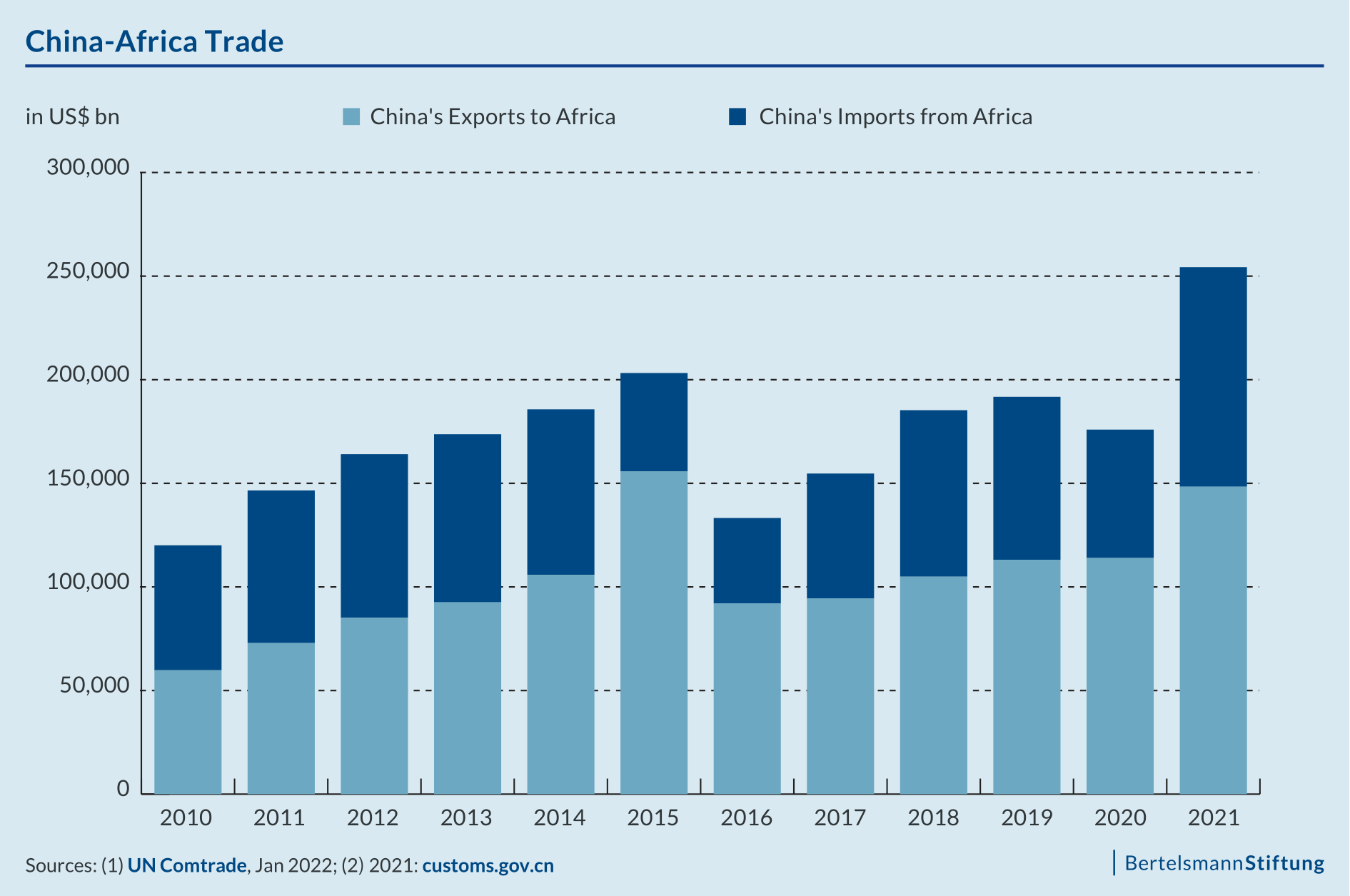
As can be seen in the graph, the previous years have been characterized by a consistent trade deficit on behalf of Africa. With respect to 2021, essential pandemic goods such as Personal Protective Equipment (PPE), pharmaceuticals or masks have boosted Chinese exports despite supply chain- and other Covid-19 related disruptions.
One of the key bodies for Sino-African relations, the Forum On China-Africa Cooperation (FOCAC), is held every three years to talk about a variety of issues concerning trade, investment, and other matters.
At the 8th Ministerial Conference of the FOCAC last year in Dakar, Beijing has declared it seeks to import goods worth USD 300 billion over the next three years to counter the trade imbalance. The focus lies on increasing agricultural imports through financial aid, as well as to support the African Continental Free Trade Area, led by the African Union.
To put this into perspective, this year’s Sino-African deficit of around USD 43 billion is almost ten times larger than that of the EU. Nevertheless, an important characteristic of European imports remains the dominance of primary goods whereas Africa continues to import mostly manufactured ones.
Regarding the top 5 Chinese trading partners on the continent, one can observe two extremes in 2021: On the one hand, Nigeria as well as Egypt are among the largest importers of goods deriving from the People’s Republic of China (PRC)- their imports account for about 90 percent of two-way trade. A big share of these imports can be attributed to large scale infrastructure projects, such as the Lagos-Ibadan railway or Egypt’s new administrative capital.
On the other hand, resource rich Angola and the Democratic Republic of Congo (DRC) almost exclusively recorded exports, in form of crude patroleum or copper to the PRC ,as their contribution to bilateral trade.
Investment
The case of FDI exemplifies well the effect of declining U.S. efforts in Africa, as China’s investment peaked in 2008, yet managed to surpass America in 2013 as the largest equity investor.
From a European perspective, the realm of FDI stock is the ground on which numerous countries, or at least their investors, outperform China: According to UNCTAD 2020 Investment Report, the Netherlands was the largest stock investor followed by the UK, France, the U.S. and China..
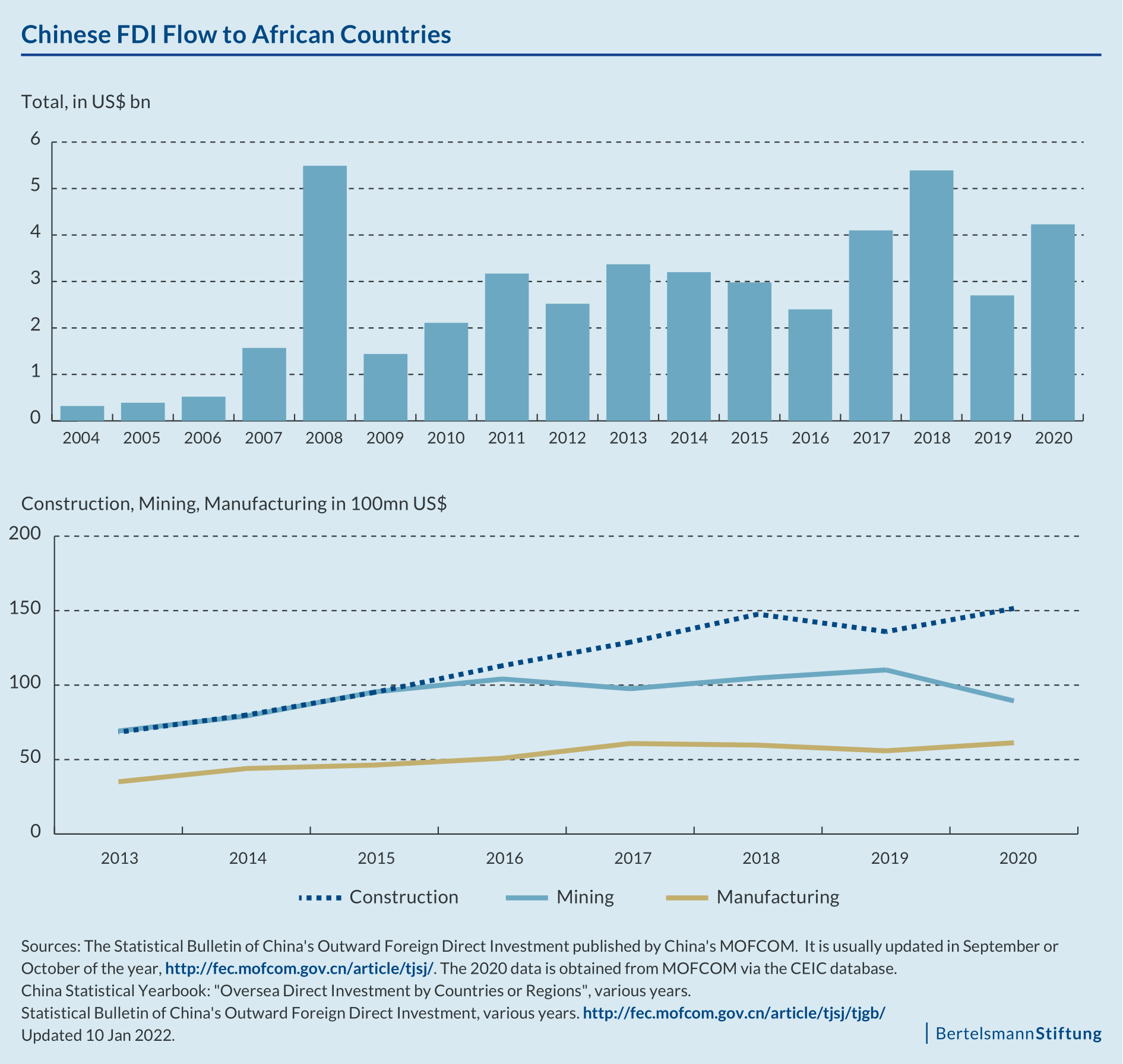
As the graph illustrates, China’s investment engagement focused primarily on infrastructure, while mining comes in second. Indeed, one third of all African infrastructure build since 2010 was both financed and constructed by Chinese State-owned Enterprises( SOE). The latter aspect of projects being carried out by Chinese entities has been at the forefront of criticism over the last years, questioning the benefit for locals and the lack of environmental or social standards.
On the contrary, the European Commission emphasized its agency of „taking into account the needs of our partner countries“ ,while launching a € 300 billion investment plan. However, given the sheer size of Sino-African projects, it is not farfetched to say that, at least during Beijing’s heyday over the last decade or so , European finance was widely regarded as more complicated and less accessible.
With respect to who it is that conducts investments, 90 percent of the 10.000 Chinese companies in Africa are “private”, according to Director of the London School of Economics’ “China-Africa” initiative Professor Shirley Yu.
At this point though, I should be clear that it is difficult to compare private firms from Europe with those from China, given the different economic and political systems in place.
Having addressed the limited nature of Chinese private entities, Mrs. Yu still argues that it is the following commercial motives that increasingly drive FDI from the People’s Republic, particularly for ”private” entities:
- Africa’s rapidly growing population depicts an attractive solution for China’s future labor shortage problems as well as increasing domestic wages
- Chinese firms see an opportunity in Africa’s growing middle class to access new consumer markets, especially in the fields of technology and communication
Loans and debt relief
Over the past 20 years, China has been Africa’s largest bilateral creditor, lending about Fehler! Linkreferenz ungültig. between 2000 and 2019, of which 80 percent was committed in the latter decade. Disregarding the 2016 numbers, that have largely been affected by refinancing measures for Angola, 2013 has seen the peak of Chinese lending to Africa. Importantly, this is the year in which the Belt and Road Initiative was formally launched.
Despite the PRC’s strong position, its aggregate volume of loans is declining: although the Covid-19 pandemic certainly contributed to the staggering low 2020 loans of USD 1.9 billion, previous years nonetheless saw steadily declining commitments. This notion can be further observed at last year’s FOCAC, which concluded one third fewer lending activity compared to the 2018 meeting.
Moreover, one can observe the effect of Beijing’s increasing debt sustainability concerns in the context of who receives major loans: countries that have previously negotiated debt restructuring measures or those who have failed to meet payments, a recent case for the latter is Zambia, have received comparably few loans. On the contrary, none of the top 5 recipients of 2019 loans have restructured any debt with China since 2000.
Similar to the findings in the FDI section, creditors from the PRC have also become more commercially orientated, as non-concessional rates have greatly increased since 2000.
The last development to be noted is the persistency in resource-backed lending models, a controversial method to secure needed financing, especially among the European and American dominated Paris Club . The case of Angola illustrates how vulnerable these practices are to commodity price shocks, as it had to file for IMF assistance following the 2015 macroeconomic developments. Despite this negative example, the DRC, Ghana, and Guinea continue to implement some form of resource backed lending.
Further Implications
The previous has showcased that China’s presence in Africa is characterized by:
- increasing trade with an effort to enhance imports through measures agreed on at the FOCAC
- changing investment patterns from largely SOE investors in infrastructure to increasing “private sector” engagement with the service industries
- more cautious creditors that have undergone the process of diversification and commercialization over time
Having laid the foundation of Chinese economic activity on the continent, it is time look at the bigger picture:
While imports of natural resources such as oil, cobalt, or copper are all of strategic importance to the People’s Republic, research shows that increasing commercial engagement is positively related to change of political alignment.
When it comes to UN voting on matters sensible to Chinese domestic affairs, may they concern Xin Jiang or Hong Kong, most African countries have either supported Beijing or abstained. The creation of support in international organizations, or at least neutrality towards its politics, is an intentional consequence of advanced Sino-African commercial activity on Beijing’s behalf.
Another interesting sphere is that of security: Some experts see China taking on a blended security approach, caused by the growing the economic footprint on the continent.
Central to that assumption is the general aversion of Chinese leadership to create a more muscular military presence in Africa, as it has portrayed itself a distinguished player from the west through “south-south” solidarity and its emphasis on national sovereignty. Yet, with about 1 million Nationals living in Africa and 44 African countries having joined the Belt and Road Initiative by 2021, the PRC sees itself increasingly exposed to security threats towards its people and projects.
Recent examples of law enforcement cooperation exemplify closer security cooperation that should be expected to enhance in the near future.
To conclude, Chinese economic engagement with the continent is rather maturing in the sense that past experiences – most notably in the realm of lending policies- lead to new strategies, than it is deteriorating. Additionally, the past 20 years of intensifying trade, investment, and loan commitments have clearly created closer cooperation in other areas, including but not limited to political alignment and security cooperation, that are just unfolding. To allow for a more comprehensive picture of China’s evolving presence in Africa, this should not be overlooked.
About the author
Leon Mosbacher is an intern at the Bertelsmann Stiftung, being involved in the China-Europe as well as Transatlantic part of the Stiftung’s Europe’s Future program. Doing his B.A. in Economics at the University of Aberdeen in Scotland, his interests include international trade and politics with a focus on Chinese economic and foreign policy. Having intern experience in China and intermediate Mandarin skills, he wants to pursue research in the realm of Chinese global politics.

Kommentar schreiben